This is the online shop of Beauty Luxury, where you can browse products, request a quotation, and place an order.
Applicable requirements
The service is provided by Beauty Luxury S.r.l. and is an e-commerce service. It is subject to the accessibility requirements of Annex I, Sections III and IV, point (f), of Directive (EU) 2019/882, transposed into Italian law by Legislative Decree No. 82 of 27 May 2022. The sections below describe how the service meets those requirements.
How the site works
Every page can be used with a keyboard alone. The first link on each page skips to the main content. The element you are on is always outlined, and menus, drawers, and dialogues return you to the control that opened them when they close.
Display settings, linked at the top of every page and in the footer, change text size, text spacing, link underlining, and contrast; your choice is stored only in your browser.
Accessibility features
Perceivable
Contrast (minimum): Where text sits on a solid background, it stands out clearly enough to be read with reduced vision, at the levelWCAGrequires. Where text sits on a photograph, the high-contrast and plain views in the display settings give it a solid background.
Resize text: Text can be resized up to 200 per cent without loss of content or functionality.
Text spacing: Line, word, and letter spacing can be increased without loss of content or functionality.
Images and colour: Images that carry meaning have a text alternative, and colour is never the only way information is given.
Operable
Every function can be reached and used with a keyboard, focus follows the reading order and stays visible, nothing flashes, and moving content can be paused.
Understandable
Every page declares its language, navigation and controls stay consistent from page to page, and form fields have visible labels with errors described in words.
Robust
Interactive components expose their name, role, and state to assistive technologies.
Buying and paying
Account creation, sign-in, quotation requests, checkout, and payment meet the points above.
Product information
Where a manufacturer provides accessibility information about a product, we publish it on the product page.
Customer support
Customer service provides information about the accessibility of the service and its compatibility with assistive technologies by telephone (+39 0541 648566), by email (info@beauty-luxury.com), andby chat.
Privacy
We do not use tracking techniques that could infer a user's disability.
How conformity is maintained
We test the site againstWCAG2.1 Level AA, using clause 9 ofEN 301 549V3.2.1. We run automated checks whenever templates, components, stylesheets, or checkout change, and review the site manually at regular intervals.
This statement read aloud
Use the read-aloud button on this page to have this statement read to you.
Hot tub water treatment: what to add, how much, how often
Bromine in the skimmer, algaecide once a week and pH between 7.0 and 7.6: what to add to hot tub water, how much based on the litres, how often, and how to disinfect the circuit.
Hot tub water needs three things, not eight: slow release bromine tablets in the skimmer, an algaecide once a week, and a test that keeps the pH between 7.0 and 7.6. Two or three times a year you add a sanitizer for the pipes. The doses depend on the litres in your tub, the rhythm is weekly, and the time it takes is ten to fifteen minutes a week, as long as you do not skip any.
This is the routine that keeps the water in order. If it already has a problem, cloudy, green or foamy, start from the guide on cloudy hot tub water: causes and fixes.
What to add to hot tub water: three products, not eight
The water treatment sheet from our technical support builds the ordinary routine on three products. The reason is practical: the fewer products you use, the fewer chances you have to mix them or get a dose wrong.
The disinfectant. Slow release bromine tablets of 20 grams, BL-SPABRO, at € 79. They go in the filter compartment of the skimmer and dissolve over about a week. The product sheet describes them as acting against bacteria, fungi and algae; they contain no chlorine and leave no smell.
The algaecide. SimplyBlu (BL-SPASIB), € 68, which besides preventing algae works against limescale, dissolved metals and organic matter. It goes into the water once a week, with filtration running.
The test. You do not pour it, you read it: test strips or a tester for pH and bromine. It is what tells you whether the other two are working, and you use it before adding anything.
The fourth product is not a weekly one. The spa sanitizer (BL-SPASAN), € 54, cleans the pipes from the inside and is needed at specific moments, listed further down in the section on disinfection. The routine products are all on the hot tub cleaning and maintenance page.
pH correctors and anti scale products are only needed when there is something to correct. With regular water changes, the sheet notes, pH correctors become almost unnecessary, because mains water usually arrives already balanced.
How much to add: start from the litres in your tub
Every dose is proportional to the volume of water, and volume varies a lot from one model to another: our heated hot tubs range from 500 litres for the smallest to 3,650 for the largest. The exact figure for your tub is in its manual and on its product page. Without that number, any dose is a guess.
For the algaecide the calculation is simple, because the product sheet gives the dose in millilitres per cubic metre:
maintenance, every 7 days: 80 to 100 ml per 10 cubic metres, which is 8 to 10 ml per 1,000 litres;
initial treatment, with freshly changed water: 150 to 200 ml per 10 cubic metres, which is 15 to 20 ml per 1,000 litres.
Two examples from the catalogue. The BL-837, 3 seats and about 720 litres, needs 6 to 7 ml a week and 11 to 14 ml at start up. The BL-831, 6 seats and about 1,560 litres, needs 12 to 16 ml a week and 23 to 31 ml at start up. On volumes this small a graduated measure is not fussiness: pouring by eye from the cap can double the dose without you noticing.
For bromine, the number of tablets is given in the technical documentation of each model, in proportion to the litres, and should not be guessed. What matters, though, is the value you measure in the water. The US CDC, in its guidance on Legionella in hot tubs, gives at least 4 parts per million of bromine (3 if you use chlorine) and a pH between 7.0 and 7.8. Our sheet keeps pH tighter, between 7.0 and 7.6, because above 7.6 the disinfectant loses effectiveness even when the amount is right.
The first treatment, after every refill
Fresh water is the moment to set everything up, because you start from zero: no organic residue and a pH that is usually already right. The sequence I suggest combines the filling sheet and the treatment sheet.
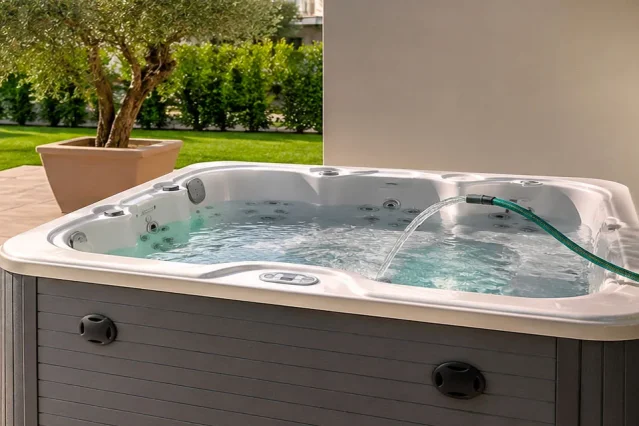
Fill with drinking water from the mains. Wells and springs are fine only if a laboratory has certified the water as drinkable: otherwise they can bring in sediment and bacteria that you then chase with chemicals.
Start the filtration and let the air out of the circuit, as described in the sheet.
Measure the pH. If it is out of range, correct it before anything else.
Pour in the initial dose of algaecide, with filtration running.
Put the bromine dose in the skimmer.
Close the cover and let the temperature rise: going from 15 to 20 °C mains water to the 36 to 40 °C working temperature takes hours, and the cover shortens them.
One rule applies to the whole sequence, and it is written in the sheet: one product at a time, never two chemicals at the same moment.
How often: a typical week
The rhythm is weekly, and the sheet warns that neglecting the checks even for a few days is enough for bacteria and algae to take hold.
Before every soak: a shower, for everyone. It is the recommendation the sheet stresses most, because sweat, creams and shampoo residue are the load the disinfectant has to deal with.
Every week: test pH and bromine, add a new bromine dose to the skimmer, add the maintenance dose of algaecide. When you use strips, do not touch the part that goes in the water: the film of sebum on your fingertips can distort the reading.
Every 4 to 6 weeks: a complete water change, for tubs under 2,000 litres. Beyond that period, the sheet explains, keeping the water in order takes more product than a refill costs. The figures are in the guide on what it costs to fill and change hot tub water.
More bathers means more checks: if more than two people use the tub every day, or it stands outdoors without a cover, test more often than once a week.
Bromine, chlorine or active oxygen?
Bromine is what our support sheet recommends for hot water: it stays more stable above 35 °C, has no smell and, in slow release form, keeps the level steady instead of making it swing with every dose. Chlorine works, but at those temperatures it calls for more frequent pH checks and indoors it leaves the familiar pool smell, which is why the sheet advises against it in a basement or a conservatory. Active oxygen costs more and may need more frequent doses; the routine algaecide is also suitable for this system.
Whichever you choose, there is one disinfectant. If you want to switch, do it at a water change, starting from fresh water rather than layering two products.
The point people miss is where bacteria live. Not mainly in the water, which the disinfectant reaches, but in biofilm: the slimy layer that forms on the inside of pipes, jets and filter, and protects them from the disinfectant. That is why the CDC, in the same Legionella guidance, puts two checks together: disinfectant above the threshold, and biofilm removed by cleaning the surfaces.
Clear water, then, is not necessarily clean. The two signs not to ignore are a smell that persists with bromine at the right level and a slimy film on the walls or near the jets: the problem is in the circuit, and adding disinfectant to the water will not solve it.
How to disinfect a hot tub: the circuit and the surfaces
Disinfecting the water and disinfecting the tub are two different jobs. Bromine works on the water. The circuit needs a sanitizer, which is circulated through the pipes and dissolves the biofilm.
On a hot tub you use the spa sanitizer (BL-SPASAN), 50 to 100 grams depending on the litres, following the instructions on the pack to the letter. The sheet lists four situations: reopening after the winter closure, coming back from a long absence, the start of the summer season, and a smell that the ordinary treatment does not remove. On a tub open to the public it is a cleaning job to do regularly.
The inside surfaces are cleaned with the tub empty, so at the end of a water change: that is also when you remove the film along the waterline.
If yours is a whirlpool bath, the kind you fill and empty every time, things are different: the water is not treated, because it does not stay in the tub. It is the circuit that needs disinfecting, and the whirlpool bath maintenance sheet sets it every 20 to 30 uses, or at least twice a year if you use it rarely: lukewarm water 5 cm above the jets, a product made for cleaning pipes, jets running for 15 to 30 minutes, then emptying and rinsing. On the acrylic surface the same sheet rules out acids, aggressive anti scale products, ammonia, solvents and abrasive powders.
What never to put in hot tub water
Traditional essential oils. The sheet forbids them: they clog the filters, leave an oily film on the surfaces and damage the filtration. For aromatherapy there are liquid, non oily fragrances made specifically for hot tubs.
Bubble bath and shampoo. The jets whip them into foam and the residue ends up in the circuit. The same goes for swimwear: rinse it without fabric softener.
Bleach and household disinfectants based on hypochlorite. They are chlorine in a form not meant for a hot tub, and they would add to the disinfectant already in the water.
Untested well or spring water. Only if a laboratory has certified it as drinkable.
A double dose "to be safe". The sheet says it plainly: never exceed the doses. Extra product does not fix a pH that is out of range, which is the most frequent reason water stops responding.
Frequently asked questions
How do you keep hot tub water clean? With a weekly routine: a shower before getting in, bromine in the skimmer, algaecide at 8 to 10 ml per 1,000 litres and a pH test, keeping it between 7.0 and 7.6. Add to that a filter rinse every 30 days and a water change every 4 to 6 weeks.
How much bromine does a hot tub need? The number of tablets depends on the litres and is given in the manual of your model. The value to check in the water is at least 4 parts per million, according to CDC guidance, with the pH in the right range: without that, even the right amount works poorly.
Does a hot tub need an anti scale product? It depends on the hardness of your mains water. According to our support sheet, up to 8 °fH nothing is needed, between 8 and 12 a softener is recommended, and above 12 it is necessary. The routine algaecide already works against limescale; on acrylic whirlpool baths, aggressive anti scale products are ruled out.
If I treat the water well, can I change it less often? Below 2,000 litres, no: the change every 4 to 6 weeks stays, because beyond that period the dissolved organic matter calls for more product than a refill costs. Treatment keeps the water in order between changes; it does not replace them.
What does it cost to treat hot tub water for a year? In the order of 200 to 300 euros in 2026, pH correctors included, for a 700 to 1,000 litre tub in family use. The disinfectant costs € 79 a pack, the algaecide € 68. The cost that really matters is energy, not chemicals.
What to do, in order
Find the litres of your tub in the manual: every dose starts from that number.
After every refill, measure the pH, pour in the initial algaecide dose (15 to 20 ml per 1,000 litres) and put bromine in the skimmer, one product at a time.
Every week, test (pH between 7.0 and 7.6, bromine at least 4 parts per million), renew the bromine and add 8 to 10 ml of algaecide per 1,000 litres.
Every 30 days, rinse the filter cartridge; every 4 to 6 weeks, change the water.
Use the circuit sanitizer when reopening, after a long absence, and when the water is clear but smells.
A shower before getting in, for everyone, and no essential oils, bubble bath or bleach in the tub.
The most common mistake is adding product when the water does not respond, without measuring the pH first. Measure first, then pour: it is the difference between a fifteen minute routine and a week of corrections.
The catalogue data in this guide (prices, seats and formats) is read from the product pages and updates with the catalogue. The litres of each model come from the technical documentation and are indicative: the exact figure is in your tub's manual. Doses, pH ranges and intervals are general guidance for domestic hot tubs under 2 cubic metres; professional and public installations are subject to different regulatory requirements, including sand filtration. Water hardness thresholds are given in French degrees, the scale used in Italy: check the equivalent scale used by your local water utility. Always follow the manual of your model and the instructions of the chemicals you use. Nothing reported here replaces an assessment by a qualified technician for your specific case.
 Skip to content