This is the online shop of Beauty Luxury, where you can browse products, request a quotation, and place an order.
Applicable requirements
The service is provided by Beauty Luxury S.r.l. and is an e-commerce service. It is subject to the accessibility requirements of Annex I, Sections III and IV, point (f), of Directive (EU) 2019/882, transposed into Italian law by Legislative Decree No. 82 of 27 May 2022. The sections below describe how the service meets those requirements.
How the site works
Every page can be used with a keyboard alone. The first link on each page skips to the main content. The element you are on is always outlined, and menus, drawers, and dialogues return you to the control that opened them when they close.
Display settings, linked at the top of every page and in the footer, change text size, text spacing, link underlining, and contrast; your choice is stored only in your browser.
Accessibility features
Perceivable
Contrast (minimum): Where text sits on a solid background, it stands out clearly enough to be read with reduced vision, at the levelWCAGrequires. Where text sits on a photograph, the high-contrast and plain views in the display settings give it a solid background.
Resize text: Text can be resized up to 200 per cent without loss of content or functionality.
Text spacing: Line, word, and letter spacing can be increased without loss of content or functionality.
Images and colour: Images that carry meaning have a text alternative, and colour is never the only way information is given.
Operable
Every function can be reached and used with a keyboard, focus follows the reading order and stays visible, nothing flashes, and moving content can be paused.
Understandable
Every page declares its language, navigation and controls stay consistent from page to page, and form fields have visible labels with errors described in words.
Robust
Interactive components expose their name, role, and state to assistive technologies.
Buying and paying
Account creation, sign-in, quotation requests, checkout, and payment meet the points above.
Product information
Where a manufacturer provides accessibility information about a product, we publish it on the product page.
Customer support
Customer service provides information about the accessibility of the service and its compatibility with assistive technologies by telephone (+39 0541 648566), by email (info@beauty-luxury.com), andby chat.
Privacy
We do not use tracking techniques that could infer a user's disability.
How conformity is maintained
We test the site againstWCAG2.1 Level AA, using clause 9 ofEN 301 549V3.2.1. We run automated checks whenever templates, components, stylesheets, or checkout change, and review the site manually at regular intervals.
This statement read aloud
Use the read-aloud button on this page to have this statement read to you.
Hot tub LED lights and chromotherapy: what they really do
LED lights are standard on our hot tubs and baths: they change the mood, they are not a treatment. Colours, evening use, running costs and contraindications.
Chromotherapy in a hot tub is a set of LED lights that colour the water: it changes the mood of your soak and there is no evidence that it treats any illness. In January 2025 the Basque health technology assessment agency published, for the Spanish Ministry of Health, a search of the clinical studies on chromotherapy: out of 201 publications screened it found none that allowed it to be assessed as a treatment. What is left is a pleasant light, which you can use well or badly.
I'll take you through how it works, what to expect, which colour to choose in the evening and who needs to be careful. I say this as someone who sells it as standard on every tub: anyone who sells tubs with chromotherapy, us included, has an interest in describing it as better than it is, which is why we cite the sources here.
How hot tub LED lights and chromotherapy work
They are LED light points in three colours (red, green, blue) fitted into the shell of the tub and powered at low voltage: 12 volts on one of the control boxes in our models. By mixing the three colours the control box obtains the others, and the water spreads them through the whole tub.
You control it from the panel, with the light button. On one of the panels in our models, that button steps through nine positions: automatic sequence, red, green, yellow, blue, purple, cyan, white, off. The procedure is on the control panel page of our support site. On the other panels the same button switches the light on and off: how you change colour depends on the model and is in the panel manual.
It is not an optional extra. As of October 2026 chromotherapy is standard equipment on all 55 models with a tub in our catalogue: 26 hot tubs, 18 whirlpool baths, 10 swim spas and one cold plunge tub. A BL-837 hot tub with 3 seats has chromotherapy as standard, like the larger models, and starts at € 5.542. This is why it is not a selection criterion: you choose the model by seats, size and jets.
In a sauna or a steam room, on the other hand, it is an accessory: the starry sky kit for the Finnish sauna starts at € 426. Everything I say here about water applies there too.
There is little to say about running costs. On one of the control boxes in our models, the light output handles 15 watts at most, against the 3,000 of the heater in a hot tub like the BL-837. One hour of light is 0.015 kWh: less than one euro cent at 2026 household tariffs. What weighs on the bill is the heat, not the light.
What chromotherapy really does: mood, not therapy
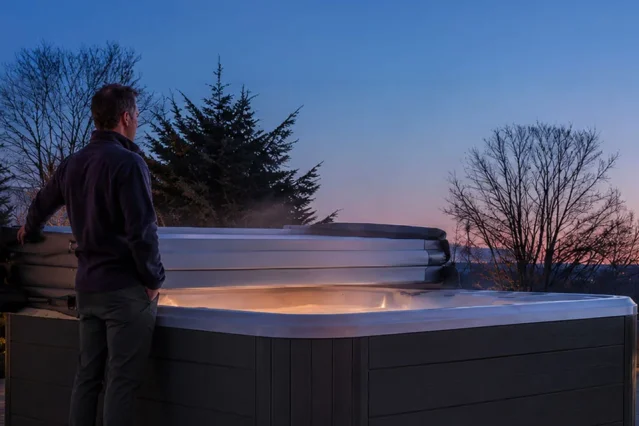
It changes the setting you bathe in. With the room light off, the coloured water becomes the only source of light, and for many people this makes the session feel more secluded. Our usage sheet recommends exactly this: soft lighting, or chromotherapy on its own.
The effect is real but subjective: you feel it, no test measures it. If blue relaxes you, use it. If the automatic sequence distracts you, choose a fixed colour.
In the chromotherapy tradition each colour is given a property: blue is calming, green balancing, red energising, yellow stimulating, purple meditative. You will find them in our manuals too, stated as principles of chromotherapy. They are traditional attributions, not results measured on patients.
What it does not do: anxiety, depression, insomnia
These are the three promises you read most often, and none of them has clinical studies behind it.
201 publications found in twelve scientific databases and registries
20 read in full, after removing duplicates and off-topic papers
0 included: no systematic review and no clinical study with a comparison group met the criteria
The conclusion is one line long: there are no studies that allow chromotherapy to be analysed as a treatment for any illness. This holds for efficacy and for safety: the report found no studies measuring either.
There is one misunderstanding to clear up. A light treatment that works does exist, and it is the one for seasonal depression: you sit every morning for 30 to 45 minutes in front of a 10,000 lux light box, about 20 times brighter than ordinary indoor light (National Institute of Mental Health, Seasonal Affective Disorder). It is a very bright light, with the UV filtered out, used with a protocol. The LEDs in a tub are mood lights of a few watts: they are not that light box and they have no therapeutic function.
If you suffer from anxiety, depression or insomnia, the question is for your doctor, not for a product page.
Which colour to use in the evening
Here science does say something useful, and it concerns sleep. In the evening any light can suppress melatonin, the hormone that prepares you for sleep, but blue light does so more powerfully. In a Harvard experiment, 6.5 hours of blue light suppressed melatonin for about twice as long as green light of comparable brightness. Red light is the least likely to shift your sleep rhythm (Harvard Health Publishing, Blue light has a dark side).
The practical rule I draw from it: if you bathe before going to bed, choose fixed red and keep the room lights low. Leave blue, cyan and white for afternoon sessions.
The limit needs stating: that experiment lasted more than six hours, a soak lasts 20 minutes. Do not expect red to make you sleep. You are only avoiding an extra disturbance.
This use makes most sense in the bathroom, where the bath is filled in the evening and emptied straight after. A BL-506 indoor whirlpool bath, with two reclining seats and 230 litres of water, starts at € 2.586.
Who needs to be careful
Photosensitive epilepsy. Around 3% of people with epilepsy have seizures triggered by light, usually by flashes between 3 and 30 per second (Epilepsy Society, Photosensitive epilepsy). If you have a diagnosis, use a fixed colour instead of the automatic sequence and talk to your neurologist first. Uncontrolled epilepsy is in any case among the conditions for which our safety sheet rules out hydromassage.
Time and temperature. The limit that counts is that of hot water. The usage sheet gives 15 to 20 minutes for a relaxing session and never more than 30 minutes in one go above 38 °C. Watching the colours is a good way to lose track of time: set a timer. The limits are on the whirlpool bath usage sheet, and who should not get into the water is covered in the guide on hot tub benefits and contraindications.
Children. There are no clinical studies on record showing that coloured light helps children sleep. For them the limits that count are those of the water: the whirlpool bath safety sheet rules out hydromassage under the age of 6 and, between 6 and 12, allows it with an adult present, at no more than 36 °C and for 15 minutes.
Frequently asked questions
What are hot tub LED lights for? To change the mood of the soak: the LEDs colour the water and, with the room lights off, become the only source of light. The effect is pleasant and subjective. It has no proven therapeutic effect.
Does chromotherapy work? As a treatment there is no evidence: a 2025 report for the Spanish Ministry of Health screened 201 publications and found no clinical study that allowed it to be assessed for an illness. As ambient lighting it works, in the sense that many people find it relaxing.
Does chromotherapy have contraindications? The light itself has one: people with photosensitive epilepsy should avoid the automatic sequence and consult their neurologist. The other contraindications are those of hot water, starting with time: never more than 30 minutes in one go above 38 °C.
What do the chromotherapy colours mean? Tradition gives blue a calming effect, green balance, red energy, yellow stimulation and purple meditation. These are traditional attributions and none is measured. The only solid fact concerns the evening: blue light suppresses melatonin more than the others, red light less.
Does chromotherapy help children sleep? There are no clinical studies on record showing it. For children the hot water limits apply: no hydromassage under 6, and between 6 and 12 always with an adult, at 36 °C at most and for 15 minutes.
How do you do chromotherapy at home? A bath or hot tub with LEDs is enough: turn off the room light, choose a colour from the panel, stay in the water for 15 to 20 minutes. In the evening fixed red is the better choice.
Do all hot tubs have LED lights? Ours do: as of October 2026 chromotherapy is standard on all 55 models with a tub in the catalogue, across hot tubs, whirlpool baths and swim spas. You do not pay extra for it.
What to do, in order
Treat it as mood lighting: out of 201 publications screened, no clinical study supports it as a cure.
Do not use it as a buying criterion: it is standard on every model, so seats, size and jets are what count.
Turn off the room light and try the fixed colours before the automatic sequence.
In the evening use red and leave blue, cyan and white for the afternoon.
Set a timer: 15 to 20 minutes, never more than 30 in one go above 38 °C.
With a diagnosis of photosensitive epilepsy, use a fixed colour and ask your neurologist before using it.
The most common mistake is buying it, or using it, as a therapy. It is how you choose the light for your bath: if you take it for that, it is unlikely to disappoint you. The next step is deciding how many people need to fit in the tub and where it will go.
Catalogue figures in this guide (seats, capacity and prices) are read from the product pages and update with the catalogue: what you see is the current value. Times, temperatures and limits of use come from the technical documentation of the products we sell, refer to a healthy adult and do not replace the instructions for your model. The information on effects and contraindications reports what the cited sources say, is for general information and does not replace medical advice: if you have a health condition, are pregnant, are on treatment or have doubts about your condition, consult your doctor.
 Skip to content