Skip to content

The difference is in what gets heated. A Finnish sauna heats the air in the cabin to 70-100 °C, at 10-20% humidity. An infrared sauna heats your body with radiant panels, and the cabin stays between 45 and 65 °C, at 5-10% humidity. Everything else follows from that: how long you wait before going in, how long you stay, how much power you need.
Neither one is better than the other. I'll take you through the differences with the figures from our technical documentation.
How they heat: the air or your body
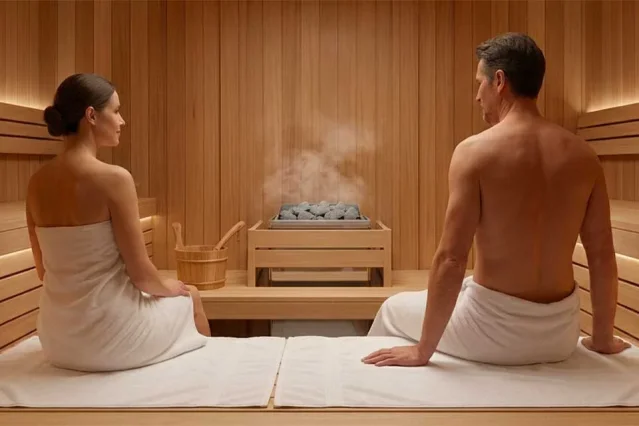
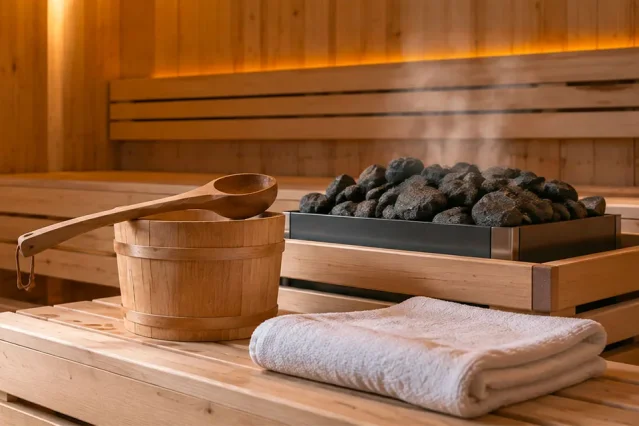
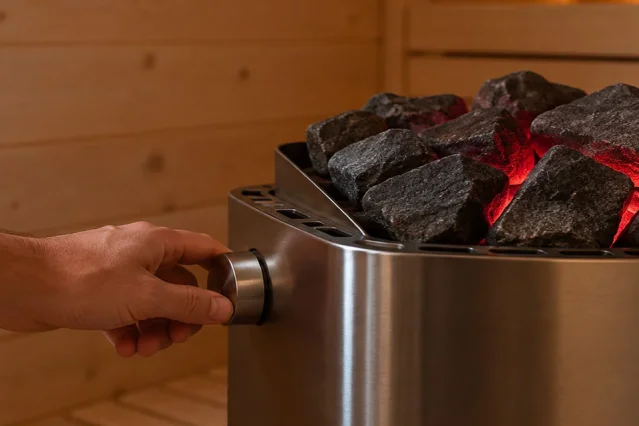
In a Finnish sauna a heater warms a basket of lava stones, the stones warm the air and the air warms you. A ladle of water on the stones raises the humidity for a few minutes, and the feeling of heat rises with it.
In an infrared sauna, carbon fibre panels give off radiation that your skin absorbs, like winter sunshine: the air stays cooler and no water is used. The panel surfaces, though, reach 80-120 °C, and our safety sheet asks you to keep at least 10 centimetres away from them.
The numbers side by side
Temperature. Finnish between 70 and 100 °C. Infrared between 45 and 65 °C, with 45-50 °C for beginners.
Humidity. Finnish at 10-20%, with short peaks when you pour water. Infrared at 5-10%, constant.
Warm-up time. A Finnish sauna needs 35-60 minutes of preheating. An infrared cabin is ready in 10-20 minutes, and you can go in while it is still warming up.
Session length. In a Finnish sauna 15-20 minutes per round, and 20 is a ceiling. In an infrared sauna from 15-20 minutes for beginners up to 30-40 for regular users, never more than 45 minutes in one go.
A different session: rounds with cold, or one sitting
A Finnish sauna works in rounds: heat, cold shower, rest, two or three times in all. The switch from hot to cold is part of the ritual, and it is also the most demanding moment for your heart and blood pressure; I have described it step by step, with the precautions, in the guide on how to use a Finnish sauna.
An infrared sauna is used in one sitting, longer and milder, and the way out is different too: cool down gradually, no cold shower straight away, at least half a litre of water and 15-30 minutes of rest. The full instructions are in our support team's guide to using an infrared sauna.
Space, weight and electrical supply
For the same number of seats the footprint is almost identical. Take two cabins for two people. The BL-181 Finnish sauna measures 100×150 cm and 200 cm high, weighs 160 kg empty, has a 3,000 W heater and starts from € 3.559. The BL-103 infrared sauna measures 110×155 cm and 190 cm high, weighs 79 kg empty, has 2,100 W of panels in total and starts from € 4.565.
The real difference is the electrical supply. A 3 kW heater takes up the whole capacity of a standard 3 kW household supply on its own, and needs a dedicated line. Most infrared cabins plug into a 16 A socket, but that too has to be on a dedicated line with a 30 mA residual current breaker, as our installation sheet explains. At four seats the gap widens: 2,800 W for infrared, 6,000 W for Finnish. One limit worth knowing: our infrared cabins are for indoor use only.
How much they use
Infrared uses less, because it draws less power and warms up in a third of the time. At the Italian regulated electricity price for the third quarter of 2026, a session costs 1.10-1.60 euro with the BL-181 and 0.40-0.60 euro with the BL-103: at two sessions a week, 110-160 euro a year against 40-60. The full calculation is in the guide on how much electricity a sauna uses.
What the research says, and where it stops
The largest studies concern the Finnish sauna: the most cited followed 2,315 men in Finland for a median of 20.7 years (Netherlands Heart Journal, 2015). They are observational studies, though, on a population that has always used the sauna: they describe habits, they do not prove effects.
On infrared there are fewer studies (Hachem et al., Cureus 2025;17(11):e98162). Neither is a medical treatment, and this guide compares them only as an experience: if you are looking for a health benefit, that is a question for your doctor.
Which one suits you
Choose the Finnish sauna if you want intense heat and steam from the stones, if the ritual with the cold shower appeals to you, and if switching the heater on an hour ahead does not bother you.
Choose infrared if you prefer a gentler heat, if you want to go in after a quarter of an hour, or if your supply cannot carry a 3 kW heater without an upgrade.
Do not choose on running costs: the difference is a few dozen euro a year.
And do not choose infrared as a «lighter» option for health reasons. The contraindications apply to both: heart or circulatory conditions, pregnancy, fever, ongoing treatment, alcohol. The full list, with temperature and time limits for children and older people, is in the safety sheets for the Finnish sauna and the infrared sauna. If you have a health condition, talk to your doctor before you buy and before you use it.
Frequently asked questions
What is the difference between a Finnish sauna and an infrared sauna?
A Finnish sauna heats the air to 70-100 °C with a heater and stones; an infrared sauna heats your body with radiant panels in a cabin at 45-65 °C, is ready in 10-20 minutes instead of 35-60, and is used in a single sitting.
Which is better, a Finnish or an infrared sauna?
Neither is better in absolute terms. The Finnish sauna gives more intense heat and the ritual with the cold shower; infrared works at a lower temperature, warms up faster and uses less power. Choose the one you will happily use two or three times a week.
Is a sauna the same as a Finnish sauna?
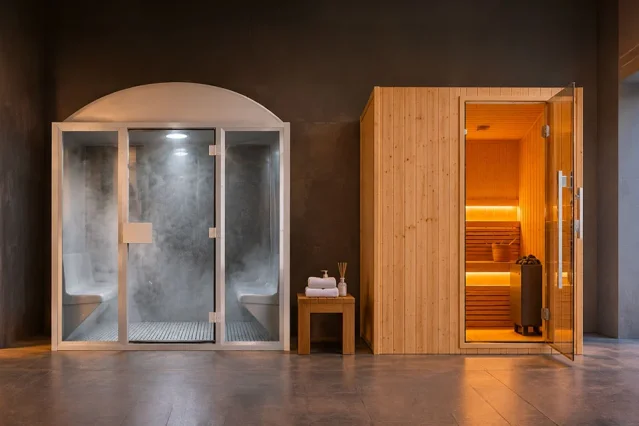
Almost always: when people just say sauna they usually mean the Finnish kind, dry heat from a heater and stones. Infrared saunas and steam rooms are different environments, with different temperatures and humidity.
Which one uses less electricity?
Infrared: 40-60 cents per session, against 1.10-1.60 euro for a Finnish sauna with a 3 kW heater.
Should you take a cold shower after an infrared sauna?
Not straight away: our safety sheet recommends cooling down gradually, then half a litre of water and 15-30 minutes of rest. The cold shower between rounds belongs to the Finnish sauna.
What to do, in order
- Decide which heat you want: air at 70-100 degrees with steam from the stones, or 45-65 degrees with the heat coming from the panels.
- Think about how you will use it: short rounds with a cold shower after 35-60 minutes of warm-up, or one sitting of 25-40 minutes after 10-20.
- Measure the room: two seats take up roughly one metre by one and a half in both cases, but infrared stays indoors.
- Check your electricity supply before ordering: a 3 kW heater takes all of a standard 3 kW supply, 2.1 kW panels leave about 900 W to spare.
- Read the contraindications in the model's safety sheet and, if you have a health condition, are pregnant or are on treatment, talk to your doctor before choosing.
The most common mistake is choosing infrared because it uses less, or Finnish because it is the one you know. Better to try both: there are 231 venues across 194 towns where you can try a sauna before buying, arranging the visit with the venue.
The models are in the Finnish saunas and infrared saunas categories, and four questions about your space and how you will use it narrow down the catalogue. Then there is our customer support and the about us page.
Catalogue figures (dimensions, weights and prices) are read from the product pages and update with the catalogue; weights refer to the empty cabin. Temperatures, times and power ratings come from the technical documentation of the cabins we sell and do not replace the manual for your model. Costs per session are a calculation based on the Italian electricity price for the third quarter of 2026. This guide is for information only: it makes no health claims and does not replace the instructions and warnings in the manual, a check of the installation by a qualified electrician, or your doctor's advice.