Skip to content

A Finnish sauna session lasts 15 to 20 minutes, and 20 is a ceiling you do not cross, not a target to reach. The rest is built in cycles: you go in, you sweat, you come out, you cool down, you rest, and then you may go back in. Two or three times in total, with the cabin between 70 and 100 °C and humidity between 10 and 20 per cent.
I am telling you straight away because it is the question I get most often, and because you will read the opposite elsewhere: that the longer you stay in, the better the sauna "works". It does not. Below you will find how a full cycle is built and the signals that mean you get out before the timer goes off.
How long you stay in: 15-20 minutes, and why that is a maximum
Our safety sheet is blunt about it: never exceed 15-20 minutes at a stretch, not even if you are experienced. It is written as a limit, not as a goal.
A beginner is better off staying 8-10 minutes and stepping out while still feeling fine. People who use a sauna regularly reach 15, and 20 remains the line you do not cross: sweating does not increase in proportion, only the strain on your cardiovascular system does.
A timer helps you respect that, and on every cabin we install it comes as standard: from the BL-110 Finnish sauna, the most compact, up to the four and five seater models, the control is a manual timer with automatic shut-off. The dial goes up to 90 minutes, but be careful: that is how long the heater runs, not how long you stay inside. Two different numbers that get confused often, and confusing them is the quickest way to stay in twice as long as you should.
Do not count the minutes in your head: heat distorts your sense of time, and almost everyone underestimates how long they have been in.
The time nobody counts: preheating
Before your 15 minutes inside there are the minutes the cabin needs to heat up. The heater starts cold and has to bring the room to between 70 and 100 °C: that takes 35 to 60 minutes depending on the output and the volume to be heated. The figures from our technical documentation:
- 3 kW (cabins of 2-4 m³): 35-45 minutes
- 4.5 kW (3-6 m³): 40-50 minutes
- 6 kW (5-9 m³): 45-55 minutes
- 9 kW (9-13 m³): 50-60 minutes
As you can see, the more powerful heater does not heat up faster: it is matched to a larger cabin, so it has more air to bring up to temperature. A compact model such as the BL-110 Finnish sauna, from € 2.973, sits at the bottom of the table; a four or five seater sits at the top. And these are times with the room at normal temperature: in winter, in a garage or a basement, add some.
How to prepare your body before going in
Preparation is what decides whether you can handle those twenty minutes.
Drink 250-500 ml of water half an hour before. Turning up already dehydrated is the leading cause of dizziness. No alcohol, before or during: it distorts your perception of heat exactly when you need it intact.
Wait 1-2 hours after a heavy meal. Digestion draws blood towards your gut, the sauna draws it towards your skin: they compete for the same resource.
Lukewarm shower, then dry off completely. Going in wet slows down sweating, because the water on your skin evaporates before your sweat does. Take off jewellery, watch and glasses too: metal at 90 degrees burns, and it heats up sooner than you expect.
On what to wear, there is one rule: naked or in a swimsuit, never in clothes. If your question is more about how to behave than what to wear, I covered that separately in the guide on sauna etiquette, where the subject is the public spa and its unwritten rules.
The full cycle: heat, cold, rest
A Finnish sauna is not done in one go. It is done in cycles, and a cycle has three parts that only work together.
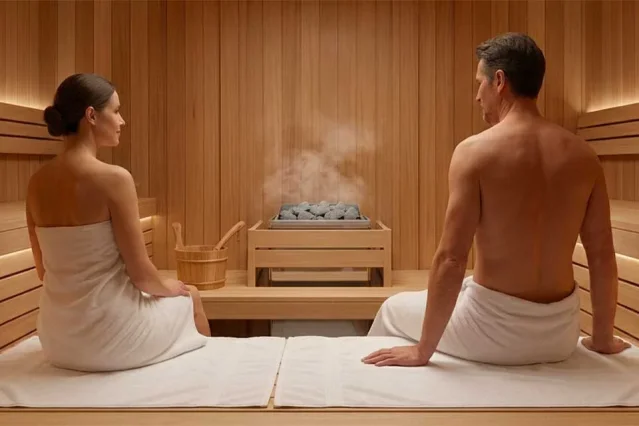
First part, the heat. Between 8 and 20 minutes in the cabin, depending on experience. You sit or lie on a towel, always: it is a matter of hygiene and it protects the wood from sweat.
Second part, the cold. A cold shower of one to six minutes, and this is the part almost everyone skips. The thermal shock is the whole point: the vasodilation of the heat followed by the vasoconstriction of the cold is what trains your vascular response, and without the second part the cycle is only half done.
The shower is the minimum form, not the only one: the traditional version is immersion, and if you do not have a lake outside your door you use a cold tub. Ours is the BL-891 ice bath, 85 × 178 centimetres for one person, with its own chiller that holds the water at the temperature you set instead of leaving you dependent on bags of ice: it starts at € 5.969. Immersion is more intense than a shower, so the timings shrink: a few tens of seconds, not six minutes, and you get out as soon as your breathing tightens.
If you have a heart condition or high blood pressure, cold water immersion is harder on you than the sauna, not easier: the shock is sudden and the blood pressure response immediate. It is the part of the cycle where your doctor's opinion matters most.
Third part, the rest. Between 10 and 20 minutes lying down, drinking. That is when your heart rate returns to normal and your body decides whether it wants another round.
Then, if you want, you start again: two or three cycles make a full session, and the total time inside the cabin should not exceed 45 minutes across all cycles. Allow an hour and a half including the rests.
Where you sit changes the temperature by ten degrees
Heat in the cabin is layered, and the difference between benches is measurable: the upper bench is up to 10 °C hotter than the lower one. This is not a detail for connoisseurs, it is the simplest lever you have to adjust the intensity without touching the thermostat.
If you are new to it, use the low bench. If you want to raise the stakes, move up. And if you want the most even distribution, lie down: sitting up puts your head in the hottest zone and the rest of you outside it, which makes the session more intense but less comfortable.
This is also why the cabin needs enough height for two real levels. On the BL-180 Finnish sauna, 150 × 150 centimetres by 200 high with three seats, the staggered benches exist precisely to give you that choice, and it starts at € 3.156. In narrower two seater cabins the choice of bench comes down to one in practice: you are comfortable, but the thermostat is all you have left to adjust with.
Water on the stones: how much, and what happens if you overdo it
Pouring water on the lava stones is what separates a Finnish sauna from a hot room. The water evaporates instantly, humidity rises for a few minutes, and the perceived heat goes up even though the thermometer does not move.
The amount is measured, though, and the figures are precise:
- Half a ladle (50-75 ml) for a light effect
- One ladle (100-150 ml) is the normal dose
- Two ladles (200-300 ml) is the absolute maximum
You do not go beyond two ladles, and it is not a matter of taste: too much water cools the stones, can damage the elements through thermal shock and makes the air unbreathable. After pouring, wait 5-10 seconds for the steam to spread.
The rule on essential oils is just as firm: sauna-specific products only, diluted at 3 to 5 drops per litre of water, never poured neat on the stones and never on the elements. Neat oil on a hot stone does not give off scent: it burns.
When to get out immediately, timer or no timer
Time is a guideline, symptoms are an order. Our safety sheet lists the signals that end the session immediately, without waiting for the timer: dizziness, nausea, irregular heartbeat, difficulty breathing, cramps, blurred vision.
Get out, lie down with your legs raised, breathe fresh air, drink. If the symptoms persist after 10-15 minutes of rest, see a doctor or go to A&E.
Then there are the conditions where you do not use a sauna at all: fever, alcohol in your system, unsupervised children. If you have a heart condition, high blood pressure or you are pregnant, that decision belongs to your doctor, not to me: intense heat changes blood pressure and heart rate, and that is the ground where a pre-existing condition weighs.
One obvious thing also needs saying, because it causes more accidents than everything else: never touch the heater or the stones, and never leave the sauna running unattended. In the service calls I handle, burns almost never come from people getting the timings wrong: they come from someone leaning on the heater on the way out, or sending a child in alone.
How often per week, and what to expect
For home use, two or three sessions a week is a sustainable frequency, and the cardiovascular benefits associated with sauna bathing come from regularity, not from the length of any single session. The most cited study followed 2,315 Finnish men aged 42 to 60 for a median of 20.7 years. The finding closest to home use: those taking two or three sessions a week had a 23 per cent lower risk of a fatal cardiovascular event than those taking one, and the reduction rose with frequency. The study is Laukkanen et al., JAMA Internal Medicine 2015 (175(4):542-548); there is an open access summary in the commentary "Sauna bathing: a warm heart proves beneficial" in the Netherlands Heart Journal.
Two honest caveats, because they are almost always left out. It is an observational study, so it shows an association and does not prove the sauna causes the effect; and the sample is Finnish men only, in a country where sauna bathing has always been a daily habit. It is not a prescription: starting with two or three sessions and seeing how you respond makes more sense than chasing a number from a paper.
What you can expect straight away is simpler: muscle relaxation and better sleep that same night. The weight you lose after a session is water, and it comes back with the first glass you drink.
First firing: three empty cycles before you use it
If the sauna is new, you do not step in on the first run. The procedure we specify is three empty firings, to burn off manufacturing residues.
- Ventilate the room with the door open for 30 minutes
- Set timer and temperature to three quarters of the dial, never maximum
- Leave the door fully open and heat for 45-60 minutes
- Switch off and let it cool completely
- Repeat 2-3 times in total
A smell of resin or burning dust during this phase is normal: it is the call I get most often the day after a delivery, and there is almost never anything to fix. The full procedure, with the checks on stones and air vents, is in the use sheet in our support section.
One last thing that affects use: the lava stones are replaced roughly every two years. Worn stones heat less well and cover the elements poorly, and the elements must stay visually covered.
Frequently asked questions
How long do you stay in a Finnish sauna?
15 to 20 minutes maximum per cycle, and 20 is a limit even for experienced users. If it is your first time, stay 8-10 minutes: your body adapts within a few sessions.
How many sauna cycles should you do?
Two or three. Each cycle is heat (8-20 minutes), cold (a shower of 1 to 6 minutes) and rest (10-20 minutes). Beyond the third, the benefit does not grow in proportion to the effort.
What temperature is a Finnish sauna?
Between 70 and 100 °C, with humidity between 10 and 20 per cent. The upper bench is up to 10 degrees hotter: you can adjust the intensity by changing seat rather than thermostat.
How long does a sauna take to heat up?
35 to 60 minutes depending on heater output and cabin size, with the room at normal temperature. In winter or in a cold room, allow a little more.
How much water do you put on the stones?
One ladle, 100-150 ml, is the normal dose. Two is the maximum: beyond that you cool the stones and risk damaging the elements.
Can you use a sauna every day?
Two or three times a week is a sustainable frequency, and regularity matters more than duration. With a heart condition, high blood pressure or during pregnancy, your doctor decides.
What do you do after a sauna?
A cold shower of 1 to 6 minutes, or immersion in a cold tub for a few tens of seconds, then rest lying down for 10-20 minutes while drinking. It is not an extra for people who tolerate cold: it is the second half of the cycle.
What to do, in order
- Drink 250-500 ml of water half an hour before, and wait 1-2 hours after a heavy meal.
- Take a lukewarm shower, dry off completely and remove jewellery and glasses: metal at 90 degrees burns.
- Set the timer and stay in 8-10 minutes as a beginner, 15-20 at most if you are used to it.
- Pour one ladle of water on the stones, never more than two, and wait 5-10 seconds for the steam to spread.
- Get out and cool down: a cold shower of 1 to 6 minutes, or immersion in a cold tub for a few tens of seconds. Then rest lying down for 10-20 minutes while drinking, which is the half of the cycle almost everyone skips.
- Repeat for two or three cycles in total, and stop immediately if you feel dizzy, nauseous or your heartbeat turns irregular.
The most common mistake is treating 20 minutes as a target instead of a ceiling, and skipping the cooling because "it is cold". If you only fix one thing in your routine, fix that one: two complete cycles are worth more than three long sessions with no cold shower in between.
If you are still choosing a model, four questions about your space and how you will use it narrow the catalogue in a minute with the sauna finder; to see the models installed there are 231 venues across 194 towns where you can try one before buying, arranging the visit with the venue. Otherwise you will find customer support and who we are.
The technical figures quoted here (temperatures, timings, water quantities and procedures) come from Beauty Luxury product documentation and apply to the cabins we sell: for other models, check the manufacturer's manual. The guidance on duration and frequency refers to healthy adults and does not replace medical advice: if you have cardiovascular conditions, high blood pressure, are pregnant or are undergoing treatment, consult your doctor before using a sauna.