Skip to content

A sauna only uses electricity while it is on, so the cost is counted per session, not per month. With a 3 kW heater, the kind fitted to two and three person cabins, a full session draws, on the calculation I show you below, between 3.5 and 5 kWh: roughly 1.10 to 1.60 euro at the Italian reference price for the third quarter of 2026. A 2.1 kW infrared sauna stays between 1.2 and 1.9 kWh: 40 to 60 cents.
I'll show you where those figures come from, how to redo them with your own heater rating and your own bill, and why the question to ask before buying is not what a session costs but whether your electricity supply can carry it. That is where most people go wrong, and the mistake does not show up on the bill: it shows up the first evening, when the power trips.
Why a sauna is paid per session, not per month
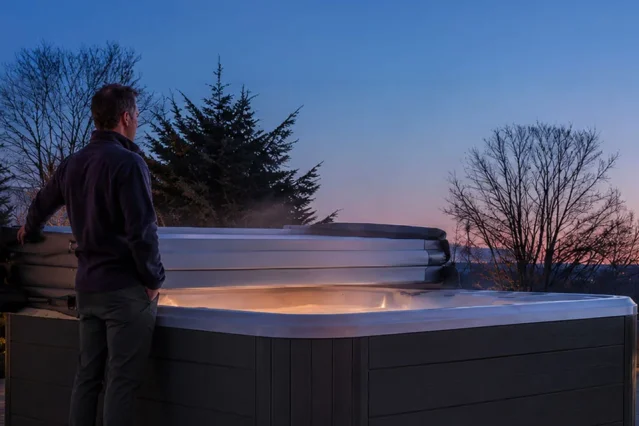
A hot tub keeps up to 1,000 litres of water at 37 °C around the clock, and its cost depends on how much heat it loses while nobody is using it. A sauna works the other way round: it sits cold and switched off between sessions, and only uses power during the two hours or so that it is running.
The consumption of a session has two parts. The first is preheating: the heater starts from cold and has to bring the cabin air to between 70 and 100 °C, running at full power. The second is holding: once the cabin is up to temperature, the thermostat switches the elements off and on to make up for the heat that escapes, and the heater no longer runs continuously.
The practical consequence is simple: two sessions a week cost twice as much as one, and a month without using it costs nothing. There is no fixed standing cost to budget for.
How much electricity a Finnish sauna uses: working it out from the heater
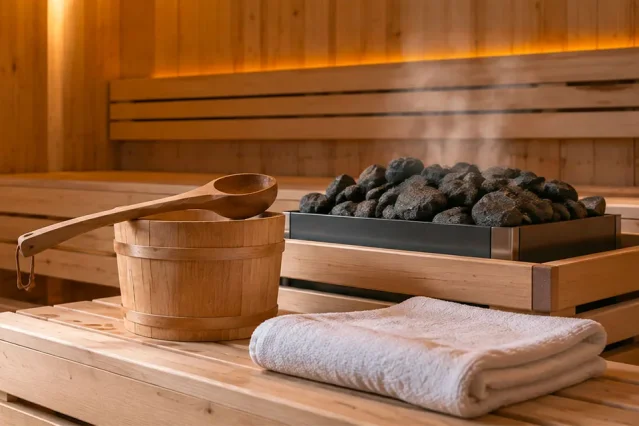
Everything starts from the heater rating, and on the cabins in our catalogue it comes in two sizes. The BL-181 Finnish sauna, 100 by 150 centimetres, has a 3,000 W lava stone heater, like the three person cabins. The BL-145 Finnish sauna, 200 by 200 centimetres, has more air to heat and a 6,000 W heater.
The preheating times are in the guide on how to use a Finnish sauna, and they come from our technical documentation: 35 to 45 minutes for a 3 kW heater, 45 to 55 for a 6 kW one. I add one hour of use with the heater on, which covers two or three rounds with breaks, and I assume that once the cabin is up to temperature the thermostat keeps the elements on about half the time. The timer on our cabins runs up to 90 minutes and then switches off on its own: for a session this long you reset it once.
- 3 kW heater: 2 kWh of preheating plus 1.5 kWh of holding, about 3.5 kWh per session. The ceiling, with the elements on the whole time, is 5 kWh.
- 6 kW heater: 5 kWh of preheating plus 3 kWh of holding, about 8 kWh per session. The ceiling is 11.5 kWh.
The ceiling is not a pessimistic guess: it is the rated power of the heater multiplied by the time it stays on. A 3 kW heater running for 100 minutes draws at most about 5 kWh. In normal use consumption stays below that, and how far below depends on how you use it.
How much electricity an infrared sauna uses
Less than half, for two reasons that add up. The panels draw less power: the BL-103 infrared sauna, 110 by 155 centimetres, has carbon panels rated at 2,100 W in total, and the four person BL-108 infrared sauna goes up to 2,800 W. And preheating is much shorter, because infrared warms the body more than the air and the cabin runs between 45 and 65 °C.
According to the use sheet in our support centre the cabin is ready in 10 to 20 minutes, and you can get in while it is still warming up, which you do not do with a Finnish sauna. With 15 minutes of warm up and a 40 minute session, the BL-103 uses between 1.2 and 1.9 kWh. The BL-108 sits between 1.9 and 2.8 kWh.
Be careful not to read this as a reason to choose one over the other: an infrared sauna and a Finnish sauna are two different experiences, with temperature ranges that do not overlap. Consumption is one criterion among several, and not the most important.
What it adds to your bill: per session, per month, per year
There is only one formula: kWh per session × price per kWh × number of sessions. The price is on your electricity bill, as the energy charge per kWh. As a reference I use the figure published by ARERA, the Italian energy regulator, for the third quarter of 2026: 31.63 cents per kWh, taxes included.
At two sessions a week, about a hundred a year, the figures look like this:
- BL-181 Finnish sauna, 3 kW heater: 1.10 to 1.60 euro per session, 10 to 14 euro a month, 110 to 160 euro a year
- BL-145 Finnish sauna, 6 kW heater: 2.50 to 3.60 euro per session, 22 to 31 euro a month, 250 to 360 euro a year
- BL-103 infrared sauna, 2.1 kW panels: 0.40 to 0.60 euro per session, 3 to 5 euro a month, 40 to 60 euro a year
- BL-108 infrared sauna, 2.8 kW panels: 0.60 to 0.90 euro per session, 5 to 8 euro a month, 60 to 90 euro a year
Three person Finnish cabins such as the BL-110 have the same 3 kW heater as the first line and the same consumption. At three sessions a week, multiply by 1.5. If you only use it in winter, halve it: a sauna left off from May to September costs nothing.
Real consumption is measured, not estimated. A smart meter shows a running total: note the reading before you switch on and when you switch off, and the difference is the kWh of that session. Do it two or three times and you know which line of the list you really are on.
Can a 3 kW electricity supply run a sauna?
With a 3 kW heater, like the one in the BL-181, only just. The heater alone takes the whole capacity of a standard 3 kW domestic supply, which is the most common contract in Italy: while it is on nothing else demanding can run, and switching on the oven or the washing machine is enough to trip the meter. Meters usually allow a small margin above the rated capacity, but not enough for a second appliance.
That is why I recommend asking your supplier to raise the capacity to at least 4.5 kW. Running it with everything else in the house switched off works until someone forgets, and it is not a condition to design an installation around: the right capacity for your home is set by the electrician, not by this guide. The upgrade has an activation fee and slightly raises the fixed part of the bill: budget for it before you buy, not after delivery.
With a 6 kW heater a 3 kW supply is not enough in any case. You need a single phase contract of at least 6 kW, or a three phase 380 V supply, which is available on request for the BL-145.
The Finnish sauna installation sheet in our support centre gives the cable size for each heater: 3x4 mm² for the 3 kW, 3x6 mm² single phase for the 6 kW. The line must be dedicated, with a residual current circuit breaker, and has to be checked by a qualified electrician before delivery.
Infrared saunas are simpler. According to the infrared sauna installation sheet most of them plug into a 16 A socket, but the line must still be dedicated and protected by a 30 mA residual current circuit breaker: a hallway socket shared with other appliances will not do. With the 2,100 W of the BL-103 there is about 900 W of headroom on a 3 kW supply: enough for lights and the fridge, not for the oven. Here too the installation has to be checked by a qualified electrician.
What pushes consumption up, and what does not
Preheating left running. It is the biggest item, because it is the only phase in which the heater always runs flat out. Every extra half hour on a 3 kW heater is worth about 0.75 kWh, even with the thermostat cycling at half. Do not reset the timer to keep the cabin warm while you wait, and never leave it on unattended: beyond the waste, it is the first safety rule of the sauna.
A cold room. A cabin in an unheated garage in January starts from 5 °C instead of 20, and takes longer to reach temperature. If you have the choice, a room inside the house uses less than an outbuilding.
An open door. Every opening lets out the hottest air, at the top, and makes the heater catch up. The etiquette of getting in and out quickly is not just courtesy to others: it is also the way of using it that consumes least.
The set temperature. Running at 80 °C instead of 100 shortens preheating and cuts the time the thermostat keeps the elements on. It is also the right temperature if you are not experienced.
What makes no difference: the ladle of water on the stones, the cabin light, the colour therapy lighting. These are loads you will not see on your bill.
Sauna or hot tub at home: which uses more
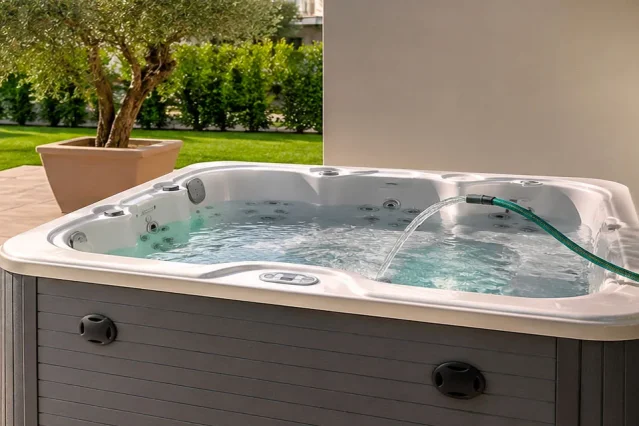
People choosing between the two ask this often, and it is a good question because the answer is clear. A hot tub with its heater uses between 3 and 7.5 kWh a day, every day, even when nobody is in it: the full calculation is in the guide on hot tub running costs.
A 3 kW Finnish sauna uses the same energy per session, and only when it is on. At two sessions a week it spends in a year what a hot tub spends in two or three winter months. That is not a reason to prefer one over the other, because they do different things: it is a reason not to rule out a sauna for fear of the bill.
Frequently asked questions
How much electricity does a sauna use at home?
A home sauna uses between 3.5 and 5 kWh per session if it is a Finnish sauna with a 3 kW heater, and between 1.2 and 1.9 kWh if it is a 2.1 kW infrared sauna. At the Italian reference price for the third quarter of 2026 that is 1.10 to 1.60 euro and 40 to 60 cents. Outside sessions consumption is negligible.
How much electricity does a Finnish sauna use?
A Finnish sauna with a 3 kW heater uses about 3.5 kWh per session, preheating included, and at most 5. With a 6 kW heater about 8 kWh, at most 11.5. At two sessions a week that is 110 to 160 euro a year for the small cabin and 250 to 360 for the four person one.
How much electricity does an infrared sauna use?
A 2,100 W infrared sauna uses between 1.2 and 1.9 kWh per session, that is 40 to 60 cents. It uses less than a Finnish sauna because the panels draw less power and the cabin is ready in 10 to 20 minutes instead of 35 to 55. A 2,800 W model sits between 1.9 and 2.8 kWh.
How many kW does a sauna need?
A sauna needs as many kW as its heater draws: 3 or 6 kW for the Finnish saunas in our catalogue, 2.1 or 2.8 kW for the infrared ones. That figure decides your supply: with a 3 kW heater it is worth raising it to at least 4.5 kW, with a 6 kW heater you need at least 6 kW or three phase. The exact value for your home is set by the electrician.
How much electricity does a sauna use per hour?
A sauna with a 3 kW heater uses at most 3 kWh in an hour, because that is its rated power: about one euro. Once the cabin is up to temperature the thermostat switches the elements off and on, so the real consumption of an hour of holding is lower, around half.
What to do, in order
- Check the heater rating on the model's spec sheet: 3 kW, 6 kW or, for infrared, 2.1 to 2.8 kW. Every calculation starts from there.
- Check your contract: with a 3 kW heater ask for at least 4.5 kW, with a 6 kW heater you need at least 6 kW or three phase.
- Have a qualified electrician check the line before delivery: dedicated line, residual current breaker and the cable size specified for your heater.
- Work out the cost with the numbers on your bill: kWh per session times price per kWh times number of sessions.
- Switch the heater on 35 to 55 minutes before you go in, no earlier, and never leave it on unattended: long preheating is the easiest thing to waste.
- Measure two or three sessions by reading the meter, and compare the result with the list in this guide.
The most common mistake is assuming that a 3 kW heater «needs no extra power» because it matches the supply rating. It is true on paper and false the first evening someone switches on the oven: the supply capacity has to be decided before you buy, together with the model.
If you want to know which heater a specific model has and what contract you need, our customer service will answer with the figures from the spec sheet. All the models are in the saunas category, and if you are not sure where to start, a few questions about your space and how you will use it narrow down the catalogue. Who we are and the experience behind this guide is on the about us page.
Source for the electricity price: ARERA, the Italian energy regulator, reference price for the third quarter of 2026 (vulnerable typical customer, 2,000 kWh a year, 3 kW supply).
Catalogue figures in this guide (model dimensions) are read from the product pages and update with the catalogue: what you see is the current value. Heater and panel ratings are those of the standard configuration. Consumption per session is a calculation, not a measurement: it is based on the preheating times in our technical documentation, one hour of use and the assumption that the thermostat keeps the elements on half the time once the cabin is up to temperature. Real consumption depends on set temperature, room, season and habits, and has to be measured on site. Electricity prices and standard domestic supply ratings vary by country, supplier and contract: use the figures on your own bill. Nothing in this guide replaces a check of the electrical installation by a qualified electrician.