Skip to content

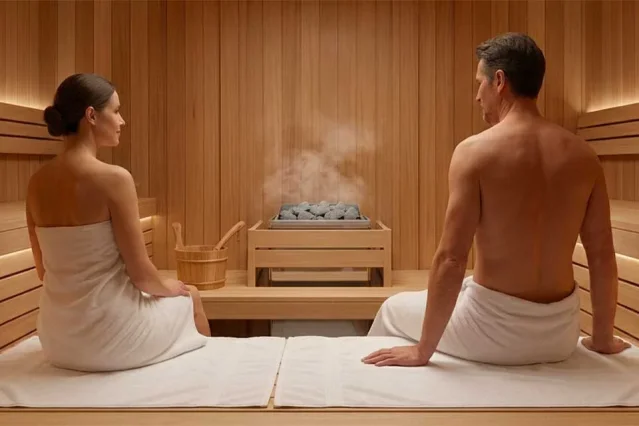
The difference comes down to two numbers: a Finnish sauna runs at 70 to 100 °C with 10-20% humidity, a steam room at 35 to 55 °C with humidity at 100%. Dry heat against saturated vapour. Everything else, from session length to which one suits you, follows from that.
They are opposite ways of producing the same effect on your body, and choosing between them is not about which is better: it depends on how you react to heat and on what you can actually install. I'll take you through the differences one at a time, with the numbers, and at the end you'll find the three cases where the choice makes itself.
The numbers that separate the two
Here is the heart of the matter, point by point. Each one is a difference in how the room works, not a preference.
Temperature. A Finnish sauna sits between 70 and 100 °C. A Turkish steam room between 35 and 55 °C, with 35-40 °C recommended if you are starting out and 48-55 °C once you are used to it. So the steam room is far cooler, and it feels like the opposite because vapour makes the sensation more intense.
Humidity. The sauna sits at 10-20%, rising for a few minutes when you pour water on the stones. The steam room is fully saturated at 100%, and that figure cannot be adjusted: it is the principle the room works on.
Session length. In a sauna you stay 15-20 minutes per cycle, with a maximum of 45 minutes in total excluding breaks. In a steam room, 15-30 minutes, with an automatic cut-off at 45.
Session structure. The sauna works in cycles: one to three, with 5-10 minutes of cooling and rehydration between them. The steam room is usually a single sitting.
Warm-up time. A steam room starts producing vapour after 5-10 minutes. A sauna has to bring a volume of wood and stone up to temperature, and takes noticeably longer.
Why 50 °C of steam feels hotter than 90 °C of dry air
Everyone asks this the first time, and the answer explains the rest.
In dry air your body cools itself by sweating: the sweat evaporates and carries heat away. At 90 °C with 15% humidity that evaporation is extremely efficient, which is why you can tolerate a temperature that looks impossible on paper.
In saturated vapour the air cannot take on any more water, so your sweat does not evaporate: it stays on your skin. The cooling mechanism is effectively switched off, and 50 °C becomes as demanding as 90 °C of dry heat. That is why a steam room runs so much cooler: it is not a gentler sauna, it is a different load produced another way.
The practical consequence concerns anyone who struggles to breathe in hot air. Dry sauna air is easier on the airways but harsher on skin and mucous membranes; vapour is more pleasant to breathe but leaves your body without its safety valve.
How to use a Finnish sauna
You go in dry, sit or lie down, and stay 15-20 minutes at most. Beginners stop at 8-12 minutes, and that is not excessive caution: it is how long your body needs to learn to handle the load.
Water goes on the stones one ladle at a time, roughly 100-150 ml, every 5-10 minutes, and never more than two ladles at once. The point is a short burst of humidity, not turning the sauna into a steam room: overdoing it simply raises the perceived heat until you have to get out.
If you use essential oils, dilute them to 3-5 drops per litre of water, and never pour them neat onto the stones.
Between cycles you step out, cool down and drink. The break lasts 5-10 minutes and it is not optional: it is the part of the cycle where the thing you came for actually happens. One to three cycles are recommended, and total heat exposure stays under 45 minutes.
This is where the cold shower belongs, as much a part of the Nordic ritual as the heat itself: a shower, a bucket of water, or a plunge if you have one. The practical rule is to start at your extremities and work towards the heart, never beginning with your head or chest.
Cooling between cycles is well established practice: in experimental protocols on Finnish sauna bathing the session is broken by a shower halfway through, and recovery happens in a cool room before going back in (Kunutsor et al., Heart and Vessels, 2018). If cold water puts you off, a few minutes of fresh air outdoors will do: what matters is that your body temperature actually comes down before the next cycle. Going back in still hot adds to the load instead of alternating it, which is the opposite of how a sauna is meant to work.
In a steam room the alternation is less codified, but the principle holds: at full saturation your body has no way of cooling itself, so the shower on the way out is not a nicety. It is the only moment when thermoregulation starts working again.
The full procedure for your model is in our support note on using a Finnish sauna.
How to use a steam room
You set the temperature and wait: vapour starts after 5-10 minutes. The session runs 15-30 minutes, and first-timers stop at 10-15.
The timer can be set anywhere between 1 and 60 minutes, but the unit shuts down on its own at 45 regardless. At the end of the cycle the system drains and cools automatically, which is also why a steam room needs less hands-on management than a sauna.
One warning matters more than it sounds: do not touch the steam outlet. Vapour leaving the diffuser is above 100 °C, and the room temperature of 50 tells you nothing about the temperature of the jet.
The first two or three times you switch it on there may be a faint smell from the heating elements: that is normal and passes, but it needs ventilation. The operating detail is in our support note on using a Turkish bath.
What each one needs to be installed, and this is where the choice narrows
This is the point where a lot of preferences settle themselves, because one of the two often simply cannot go in.
A steam room needs a water supply, a dedicated drain and a vapour outlet to the outside. The requirements for the room, taken from our installation note, are these: a ceiling at least 220-230 cm high, a flat waterproof floor with a tolerance of 2 mm per metre, a drain with a minimum fall of 2%, and a vapour pipe no longer than 3 metres, angled downwards and at least 150 mm away from the seating.
On the electrical side you are looking at 3 kW single-phase on the smaller units up to 10.5 kW three-phase on the larger ones, with breakers from 16 to 40 A and 30 mA residual current protection. It also wants water that is not too hard: with hard water you need a softener, because limescale is the main enemy of a steam generator.
A Finnish sauna needs neither water nor drainage. It needs power sized for the heater, proper ventilation, and a space that can take both the structure and the temperature.
In practice: in an existing bathroom, with drainage and an outlet already available, a steam room fits in more easily. In a dry room with no plumbing, the sauna is the only one of the two you can install without building work. If you want the full picture of what a steam room needs at home, I covered it in the guide on installing a Turkish bath at home.
To give you a concrete sense of scale: a two-seat Finnish sauna like the BL-180 takes up 150×150 cm and stands 200 cm tall, starting at € 3.156; a two-seat steam room like the BL-2B fits in 120×130 cm at 215 cm tall, starting at € 3.650. For the same number of seats the footprint is similar, but the steam room is taller, which is why the ceiling constraint falls on it and not on the sauna.
Going up in size the ratio shifts: a four-seat Finnish sauna like the BL-148 reaches 200×200 cm at € 7.186, while the BL-4B steam room stays at 130×190 cm for € 4.005. All models and dimensions are in their respective categories: Finnish saunas and Turkish bath.
When you should use neither
The contraindications largely overlap, and this is the part of the guide worth reading in full even if you already know the rest.
For both, avoid them if you are pregnant without medical clearance, if you have a cardiac condition your doctor has not cleared, uncontrolled high blood pressure, a fever or an acute infection. For the steam room, add thrombosis. For the sauna, open wounds and severe circulatory disorders.
And for both there is the rule most often ignored: do not go in after drinking alcohol. Alcohol interferes with thermoregulation and with your ability to notice you are unwell, which means it disables the very signal that should tell you to get out.
Get out straight away, without waiting, if you feel dizzy or nauseous, if your heart is racing, or if you have trouble breathing or pain in your chest. This is not an alarmist list: in a room at 50 °C with 100% humidity, the time between the first symptom and not being able to stand up is shorter than anyone expects.
If your question is about hot tubs during pregnancy, which has its own rules and different ones, I wrote about it in a separate guide.
Which of the two suits you
Three cases where the answer is clear, and one where it is not.
Choose the steam room if very hot air is unbearable for you, if you already have a bathroom with drainage and an outlet, or if you want a single short session without managing cycles.
Choose the sauna if there is no plumbing where you want to put it, if dry heat suits you better, or if the cycle-and-cool-down ritual is what appeals to you.
Do not choose on the basis of which one is better for you: that is the criterion that most often leads people the wrong way. Both produce a vascular response to heat, and the mechanism is the same; only the route differs. What actually matters is which one you will use, and that depends on which one you can happily sit in for twenty minutes.
The unclear case is having the space and the services for both. There the question becomes a different one, which is which you will use more often, and the sensible move is to try both at a spa before deciding. Twenty real minutes tell you more than any comparison on paper, this one included.
Frequently asked questions
What is the difference between a sauna and a steam room?
A Finnish sauna runs at 70-100 °C with 10-20% humidity, a Turkish steam room at 35-55 °C with humidity at 100%. Dry heat against saturated vapour: in the first your sweat evaporates and cools you, in the second it cannot, which is why the steam room works at much lower temperatures.
Is a sauna or a steam room better?
It depends on how you tolerate heat and on what you can install. A steam room needs water, drainage and a vapour outlet; a sauna needs none of those, but wants more space and power for the heater. In terms of effect neither is better: what changes is how you get there.
How long should you stay in a sauna or a steam room?
In a sauna, 15-20 minutes per cycle, one to three cycles, with 5-10 minute breaks and no more than 45 minutes of total exposure. In a steam room, 15-30 minutes in one sitting, with automatic shut-off at 45. Beginners stop at 8-12 minutes in a sauna and 10-15 in a steam room.
Should you take a cold shower after a sauna?
It is part of the Nordic ritual and it has a practical point: between cycles your body needs to cool down properly, or the next cycle adds to the load instead of alternating it. Start at your extremities and work towards the heart. If cold water puts you off, a few minutes of fresh air will do: what counts is that your temperature drops, not that the water is freezing.
Do you do the sauna or the steam room first?
If you are doing both in the same session, start with the steam room and move on to the sauna: you work up in temperature rather than down, and the vapour prepares your airways. Either way there is a cooling break and a drink between the two.
Can a steam room go into an ordinary bathroom?
If the ceiling is at least 220-230 cm, the floor is flat and waterproof, there is a dedicated drain and you can run a vapour outlet to the outside, yes. Water hardness needs checking too: with hard water you need a softener, because limescale damages the steam generator.
Can you use a sauna every day?
Frequency is not the main limit: session length and rehydration between cycles are. Staying within 45 total minutes and drinking during the breaks, regular use falls within the operating guidance. If you have a cardiac condition or high blood pressure, agree the frequency with your doctor.
What to do, in order
- Start from what you can install: with no water supply, drain and vapour outlet the steam room rules itself out, and the choice is made for you.
- Measure the clear height of the room: below 220-230 centimetres a steam cabin will not fit.
- Ask yourself which kind of heat you genuinely tolerate, because between 90 degrees of dry air and 50 degrees of saturated vapour the difference in sensation is sharp and personal.
- Think about the time you have: a steam room is ready in 5-10 minutes and works as a single sitting, a sauna needs longer to warm up and pays off in cycles.
- Budget for the cold shower between cycles: it is what makes the alternation work, not an extra for people who like the cold.
- If you have a cardiac condition, high blood pressure or you are pregnant, talk to your doctor before choosing: the contraindication applies to both.
The most common mistake is choosing on the basis of what you have read rather than how you feel inside. If you have the space and the services for both, the concrete next step is to try them at a spa on the same afternoon: twenty real minutes settle the question better than any comparison on paper, this one included.
If you want a feasibility check on your own room, our customer support will go through measurements and connections before you order. The models are in the two categories, Finnish saunas and Turkish bath. Who we are and what we do is on the about us page.
Catalogue figures in this guide (dimensions, capacity and prices) are read from the product pages and update with the catalogue: what you see is the current value. Temperatures, session times and humidity are the operating values of our own units and do not replace the manual for your model. The guidance on who should avoid saunas and steam rooms is general and does not replace medical advice: if you have a cardiac condition, high blood pressure, are pregnant or are undergoing treatment, that assessment belongs to a doctor.