This is the online shop of Beauty Luxury, where you can browse products, request a quotation, and place an order.
Applicable requirements
The service is provided by Beauty Luxury S.r.l. and is an e-commerce service. It is subject to the accessibility requirements of Annex I, Sections III and IV, point (f), of Directive (EU) 2019/882, transposed into Italian law by Legislative Decree No. 82 of 27 May 2022. The sections below describe how the service meets those requirements.
How the site works
Every page can be used with a keyboard alone. The first link on each page skips to the main content. The element you are on is always outlined, and menus, drawers, and dialogues return you to the control that opened them when they close.
Display settings, linked at the top of every page and in the footer, change text size, text spacing, link underlining, and contrast; your choice is stored only in your browser.
Accessibility features
Perceivable
Contrast (minimum): Where text sits on a solid background, it stands out clearly enough to be read with reduced vision, at the levelWCAGrequires. Where text sits on a photograph, the high-contrast and plain views in the display settings give it a solid background.
Resize text: Text can be resized up to 200 per cent without loss of content or functionality.
Text spacing: Line, word, and letter spacing can be increased without loss of content or functionality.
Images and colour: Images that carry meaning have a text alternative, and colour is never the only way information is given.
Operable
Every function can be reached and used with a keyboard, focus follows the reading order and stays visible, nothing flashes, and moving content can be paused.
Understandable
Every page declares its language, navigation and controls stay consistent from page to page, and form fields have visible labels with errors described in words.
Robust
Interactive components expose their name, role, and state to assistive technologies.
Buying and paying
Account creation, sign-in, quotation requests, checkout, and payment meet the points above.
Product information
Where a manufacturer provides accessibility information about a product, we publish it on the product page.
Customer support
Customer service provides information about the accessibility of the service and its compatibility with assistive technologies by telephone (+39 0541 648566), by email (info@beauty-luxury.com), andby chat.
Privacy
We do not use tracking techniques that could infer a user's disability.
How conformity is maintained
We test the site againstWCAG2.1 Level AA, using clause 9 ofEN 301 549V3.2.1. We run automated checks whenever templates, components, stylesheets, or checkout change, and review the site manually at regular intervals.
This statement read aloud
Use the read-aloud button on this page to have this statement read to you.
You sit in a sauna naked, on a towel. Why a swimsuit makes the session worse, sauna etiquette in six rules, how long to stay in at each temperature, and the conditions that rule it out entirely.
You go into a sauna naked, sitting on a towel. This is not about Nordic custom or modesty: it is how the room is meant to work, and a swimsuit is the one thing that genuinely makes the session worse. I'll explain why, then the rest of the etiquette: six rules, and you'll have them in five minutes.
The part that catches people out is different. Plenty of spas and wellness centres, especially in southern Europe, require a swimsuit in mixed areas, so the correct practice and the house rule do not line up. Here is how to handle both, how long to stay in, at what temperature, and when you should not go in at all.
Why you sit in a sauna without a swimsuit
There are three reasons, and none of them is aesthetic.
Fabric traps heat against the skin. At 80 or 90 °C a wet swimsuit becomes a warm compress that stops sweat evaporating. Sweating is how your body regulates itself in there, so covering it is like wearing a blanket over exactly the part that needs to breathe.
Synthetic materials are not built for that heat. Elastane, lycra and polyester are designed for pool water, not for dry air at 90 °C. The mechanism is documented: when sweat cannot evaporate and stays trapped, the sweat ducts can become obstructed and miliaria can appear. The MSD Manual explicitly advises avoiding occlusive clothing, which is what a wet swimsuit can become in a cabin at 90 °C. Added to that there can be textile contact dermatitis, which according to DermNet often comes not from the fibre itself but from the dyes and finishing agents.
Hygiene is solved by the towel, not by the swimsuit. The towel goes on the bench and catches the sweat. A swimsuit keeps it against you, along with chlorine and detergent residue, and then releases all of it into a shared room.
Flip flops follow the same logic: leave them outside the cabin. Rubber is another plastic with no reason to be in there.
What if the spa requires a swimsuit?
It happens often, and it is usually a house rule, tied to how mixed areas are managed. The honest position is this: you follow the rule of the place you are in, knowing it is a compromise.
If you have no choice, three things reduce the discomfort. Pick cotton or linen, never synthetic. Put it on dry rather than straight out of the pool. And shorten the session, because trapped heat will bring you to your limit sooner.
It is also why people who use a sauna regularly end up wanting one at home: the compromise disappears, and so does the question of who else is in the room. Our sauna range starts with compact cabins like the BL-180 Finnish sauna, which takes up 150 by 150 centimetres and seats 3.
Sauna etiquette in six rules
These apply in a public sauna and at home when you have guests. None is complicated, but nobody knows them the first time.
Shower before you go in, and dry off properly. You enter clean and dry: wet skin sweats badly.
Towel under your whole body, feet included. Wood should not touch skin or collect sweat.
Keep talk short and quiet. Many northern saunas are silent, and that is the right register anywhere.
No phone. Beyond the manners, there is the electronics: at 90 °C batteries and screens take damage.
Open and close the door quickly. Every opening drops the temperature and forces the heater to catch up.
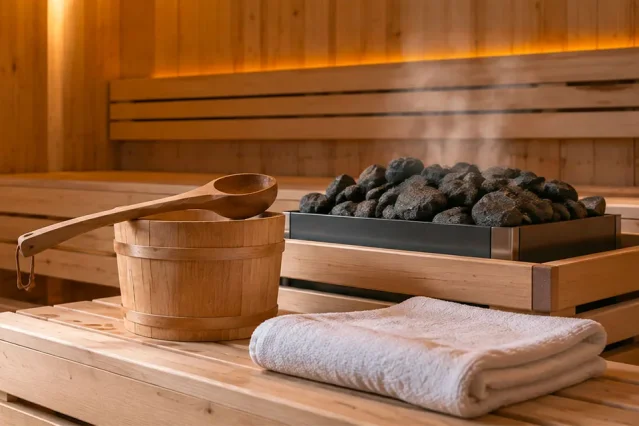
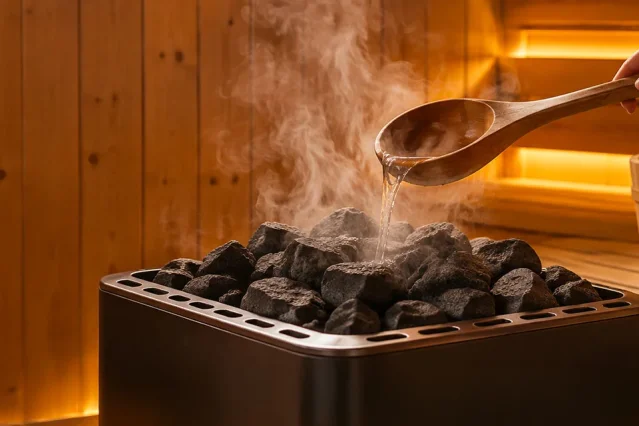
Pour water on the stones sparingly, and ask the others first. One ladle of 100 to 150 ml every 5 to 10 minutes is the normal dose, and you never exceed two ladles at once.
One technical note on that last point: water never goes on electrical components, and essential oils never go directly on the stones. Dilute them, 3 to 5 drops per litre of water.
How long should you stay in a sauna?
The short answer: 8 to 15 minutes per round, and never more than 45 minutes in total across all rounds. Staying in until you can't take it is not a better sauna, it is just dehydration.
The right duration depends on how used to it you are, and it moves together with the temperature.
Who you are
Temperature
Per round
First time, or close to it
70-75 °C
8-12 minutes
Regular use
80-90 °C
10-15 minutes
Experienced
85-100 °C
8-15 minutes
Children from 7, with an adult
60-70 °C
5-8 minutes
Over 65, after medical advice
65-75 °C
8-12 minutes
A full cycle works like this: first round of 8 to 12 minutes, cooling break of 5 to 10, second round of 10 to 15, then 10 to 15 minutes cooling down. A third round of 8 to 10 minutes is for people with experience, not for a first visit.
Notice the detail almost everyone skips: the break lasts as long as the round. A traditional sauna is alternating hot and cold, not time spent inside. Three rounds without breaks is a different thing from what the usage sheet describes.
Hydration numbers are just as specific: 250 to 500 ml of water in the hour before, 200 to 300 between rounds, 500 to 750 afterwards. No alcohol, before or during. The full procedure is in our guidance on using a Finnish sauna.
The cold shower afterwards, done properly
The cold stage is part of the session, not an optional dare. But the order matters, and mistakes here have consequences.
Step out of the cabin, stand in the air for a moment, and start from the extremities: feet first, then legs, then arms, and only at the end your torso and head. Going straight under cold water starting from your chest is the classic way to get dizzy, because the change is too abrupt. With heart or blood pressure problems, ask your doctor before going from hot to cold.
The useful duration is short: 1 to 6 minutes, and for most people one or two is plenty. Then dry off and rest before the next round.
There is a lot of metabolic folklore around this, from brown fat to calories burned. The honest position is that the literature on those mechanisms exists but is far weaker than the way it gets retold: a sauna is a wellness and recovery practice, not a weight loss tool. Anyone selling it as one is overstating the case.
When you should not use a sauna
This is the part wellness articles almost always skip, and it matters most. Some conditions rule it out entirely.
The safety sheet rules out use with a fever above 37.5 °C, with an active infection, after a recent heart attack (6 to 12 months), with unstable angina or severe heart failure, with uncontrolled epilepsy, or with a recent venous thrombosis. During pregnancy a sauna is ruled out in the first and third trimesters, and in the second only with your obstetrician's approval.
According to the same sheet, ask your doctor first if you have high or low blood pressure, diabetes, asthma or chronic respiratory disease, kidney or thyroid problems, significant varicose veins, acute skin conditions, or if you are undergoing chemotherapy or radiotherapy.
Watch the medication, because that is the interaction people miss: diuretics, beta blockers, anticoagulants, antidepressants, antihistamines and vasodilators all change how your body responds to heat. If you take something regularly, that conversation happens before your first session, not after.
Get out immediately if you feel dizzy or nauseous, get a bad headache, notice your heart racing, struggle to breathe, cramp up, or your vision blurs. If it does not pass after 10 to 15 minutes of rest, call a doctor. The full detail, including rules for children and older adults, is in our sauna safety guidance.
On children the rule is firm: never under 3, not advised between 4 and 6, and from 7 upwards only with an adult, on the lower bench, and after speaking to a paediatrician. Never leave a child alone in the cabin, not even for a few seconds.
A sauna at home: what changes
At home the etiquette gets simpler, because you decide who comes in. The technical rules stay, since they do not depend on who is watching: towel under you, shower first, door closed quickly, water on the stones in measure.
Two things genuinely change. The first is preheating, which is now your problem: a 3 kW heater needs 35 to 45 minutes, a 6 kW one 45 to 55, and a 9 kW unit up to an hour. Build it into the evening, or you walk into a lukewarm cabin.
The second is frequency: 2 to 3 sessions a week for occasional use, up to 4 for regular users. Having one at home pushes you to use it more, which is exactly when it helps to remember the limit exists.
On models, the order of magnitude: the BL-180 Finnish sauna seats 3 and starts at € 3.156, while a wider cabin like the BL-145 Finnish sauna takes 4 people across 200 by 200 centimetres. Dimensions matter more than the seat count: at 200 centimetres of height the upper bench is where the real heat sits, and you only lie down on it if the cabin is long enough.
Frequently asked questions
Do you go in a sauna naked or in a swimsuit? Naked, sitting on a towel. That is correct practice because fabric traps heat and sweat against the skin, and synthetics at 90 °C can irritate it. If the venue requires a swimsuit, choose cotton or linen and keep the session shorter.
Why do people use saunas without a swimsuit? Three technical reasons: sweat has to be able to evaporate, synthetic fabrics are not made for dry air at those temperatures, and hygiene is handled by the towel under your body rather than by what you wear.
How long should you stay in a sauna? 8 to 15 minutes per round depending on habit and temperature, with cooling breaks of the same length. The total stays under 45 minutes, and beginners stop at 8 to 12 minutes at 70-75 °C.
Are saunas mixed gender? It depends on the venue: some have separate cabins or separate hours, others do not. In a mixed sauna the etiquette is identical, and the towel also does the job of privacy. At home the question does not arise.
Can you use a sauna during your period or while pregnant? With a heavy period the usage sheet advises against the sauna; on other days the general rules on hydration and duration apply. During pregnancy a sauna is ruled out in the first and third trimesters, and in the second only with your obstetrician's approval.
Can you take a phone into a sauna? No, and not only out of courtesy: at 80 to 90 °C lithium batteries and screens take damage, and a phone left on the upper bench can swell. It stays outside with the flip flops.
What to do, in order
If this is your first time, the sequence is this.
Shower and dry off before going in, with a towel under your whole body.
Lower bench, 70-75 °C, 8 to 12 minutes. The upper bench is hotter: you work up to it, you do not start there.
Come out and cool down for as long as you were inside, starting from your feet under cold water.
Drink between rounds, 200 to 300 ml. No alcohol.
Three rounds maximum, and never more than 45 minutes total inside the cabin.
The most common mistake is treating endurance as an achievement: twenty minutes straight is not a successful sauna, it is a badly run one. The second is skipping the cooling stage, which is half of the session.
If you have a medical condition or take medication regularly, your next step is not choosing a temperature: it is asking your doctor before the first session.
Who we are and the experience behind these guides is set out on our about us page. For your specific case you can write to us through the contact page, and warranty terms are in our sales terms and conditions.
The catalogue figures in this guide (dimensions, seats and prices) are read from the product pages and update with the catalogue: what you see is the current value. Temperatures, durations and dosages are general guidance for a healthy adult and do not replace the instructions for your model. The information on contraindications and medication does not replace medical advice: if you have a health condition, are pregnant, or are undergoing treatment, speak to your doctor before using a sauna.
 Skip to content