This is the online shop of Beauty Luxury, where you can browse products, request a quotation, and place an order.
Applicable requirements
The service is provided by Beauty Luxury S.r.l. and is an e-commerce service. It is subject to the accessibility requirements of Annex I, Sections III and IV, point (f), of Directive (EU) 2019/882, transposed into Italian law by Legislative Decree No. 82 of 27 May 2022. The sections below describe how the service meets those requirements.
How the site works
Every page can be used with a keyboard alone. The first link on each page skips to the main content. The element you are on is always outlined, and menus, drawers, and dialogues return you to the control that opened them when they close.
Display settings, linked at the top of every page and in the footer, change text size, text spacing, link underlining, and contrast; your choice is stored only in your browser.
Accessibility features
Perceivable
Contrast (minimum): Where text sits on a solid background, it stands out clearly enough to be read with reduced vision, at the levelWCAGrequires. Where text sits on a photograph, the high-contrast and plain views in the display settings give it a solid background.
Resize text: Text can be resized up to 200 per cent without loss of content or functionality.
Text spacing: Line, word, and letter spacing can be increased without loss of content or functionality.
Images and colour: Images that carry meaning have a text alternative, and colour is never the only way information is given.
Operable
Every function can be reached and used with a keyboard, focus follows the reading order and stays visible, nothing flashes, and moving content can be paused.
Understandable
Every page declares its language, navigation and controls stay consistent from page to page, and form fields have visible labels with errors described in words.
Robust
Interactive components expose their name, role, and state to assistive technologies.
Buying and paying
Account creation, sign-in, quotation requests, checkout, and payment meet the points above.
Product information
Where a manufacturer provides accessibility information about a product, we publish it on the product page.
Customer support
Customer service provides information about the accessibility of the service and its compatibility with assistive technologies by telephone (+39 0541 648566), by email (info@beauty-luxury.com), andby chat.
Privacy
We do not use tracking techniques that could infer a user's disability.
How conformity is maintained
We test the site againstWCAG2.1 Level AA, using clause 9 ofEN 301 549V3.2.1. We run automated checks whenever templates, components, stylesheets, or checkout change, and review the site manually at regular intervals.
This statement read aloud
Use the read-aloud button on this page to have this statement read to you.
Opening a spa in Italy: hotel or public, permits and costs
Before any equipment, decide what you are opening: a spa for the guests of an accommodation business or a wellness centre open to the public. Permits, supervision, water, equipment and costs.
If you are opening a spa or a wellness centre in Italy, decide what you are opening before you choose any equipment, because permits, staff and costs all follow from it. A spa that serves your own guests (hotel, B&B, agriturismo) is one thing. A wellness centre open to the public, selling sessions to whoever walks in, is another. In the second case sauna and steam room often fall under the beauty therapy rules (the Modena Chamber of Commerce sheet cited below is one example): you usually need a formal notice to the municipality and a qualified technical manager.
I'll take you through what changes between the two cases, what the rules say about supervision and water, which technical data to check when equipment is meant for shared use and which items belong in the quote. One warning applies to the whole guide: many of these rules are regional and municipal, so the end point is always a written answer from your municipality and your local health authority (ASL). If the spa is for your own home, the right guide is the one on the home spa.
A spa for your guests or a centre open to the public: what changes
The difference is who pays, and for what. If sauna, steam room and hot tub are an extra for the people staying with you, they are an activity complementary to the accommodation. If they are the reason the customer comes in and pays, they are a business of their own.
A concrete example comes from Emilia-Romagna. The information sheet on starting a beauty therapy business published by the Modena Chamber of Commerce (in Italian) excludes sauna, steam room and hot tub from beauty therapy when they are complementary services of gyms, sports facilities and accommodation businesses. Outside that case the sheet brings sauna and steam room under beauty therapy; for a hot tub offered to the public, ask the municipality how it is classed.
Other regions and many municipalities have their own regulations, and they do not always match. That is why the first question goes to your municipality's one stop business desk, before any project: the service I want to offer, in these premises, what kind of business is it?
What you need to open a wellness centre open to the public
If the centre is open to the public, the path is the one for beauty therapy, governed by Italian Law no. 1 of 4 January 1990. Three requirements emerge from the Modena sheet.
The SCIA, the certified notice of start of business, filed with the municipality's one stop desk for productive activities (SUAP). Many SUAP offices receive it through the impresainungiorno.gov.it portal.
A technical manager holding the professional beautician qualification: the owner, a partner working in the business or a legal representative. The sheet asks for this person in the SCIA itself.
Compliant premises under the building regulations and the municipal regulation for beauty therapy, plus registration with the Business Register.
A private spa rented by the hour, meaning a wellness suite let exclusively to a couple or a small group, is not covered by any of the sources cited. It does sell the use of sauna and hot tub to people who are not staying with you: the prudent course is to describe it that way to the SUAP, ask in writing how it is classed, and allow for it being treated as a centre open to the public.
Does a hot tub in a hotel need a lifeguard?
It depends on the region. The national reference is the State and Regions Agreement of 16 January 2003 on swimming pools (in Italian). Point 4.1 requires lifeguards to be present continuously at every pool. Point 2.2 classes the pools of hotels, campsites and holiday complexes open only to guests as pools for collective use.
Two details change the picture. First, the Agreement lists eight types of pool (for swimmers, for diving, recreational, for children and so on) and does not mention hot tubs. Second, at point 9.1 it lets the regions set their own implementing arrangements for the pools of tourist accommodation and agriturismi reserved for guests.
The subject is also moving. As of October 2026 the XII (Social Affairs) Committee of the Italian Chamber of Deputies is examining the bill «Framework law on health and safety in swimming pools» (A.C. 2576, introduced on 11 August 2025). In the submission filed with the committee (May 2026), the hoteliers' association Confindustria Alberghi asks, among other things, for hot tubs to be expressly excluded from the scope of the law and, for pools reserved for hotel guests, for supervision to be allowed as an alternative to a lifeguard being physically present, with compensating measures such as a poolside attendant trained in first aid. A sign that, in the text under discussion, the question is still open.
My practical advice is one thing: before you order, ask the public health department of your ASL in writing how it classes a six seat hot tub reserved for guests, and what supervision it requires. That answer is worth more than any guide, this one included.
Legionella: the part you cannot hand over
The second constraint is the water, and here the guidance is national. The Italian Guidelines for the prevention and control of legionellosis (in Italian), approved by the State and Regions Conference on 7 May 2015, have a paragraph on hot tubs in tourist accommodation, which they identify as a known cause of cases of Legionnaires' disease. The measures are specific:
automatic and continuous treatment with an oxidising disinfectant, preferably chlorine; manual dosing only in an emergency
free chlorine between 0.7 and 1.5 mg/L and pH between 7.0 and 7.6, measured before use and every two hours during use
pumps and disinfection running 24 hours a day
a sand filter backwashed every day: for commercial use and holiday accommodation the guidelines rule out paper or polyester filters
Legionella testing every three months and a microbiological check of the water every month
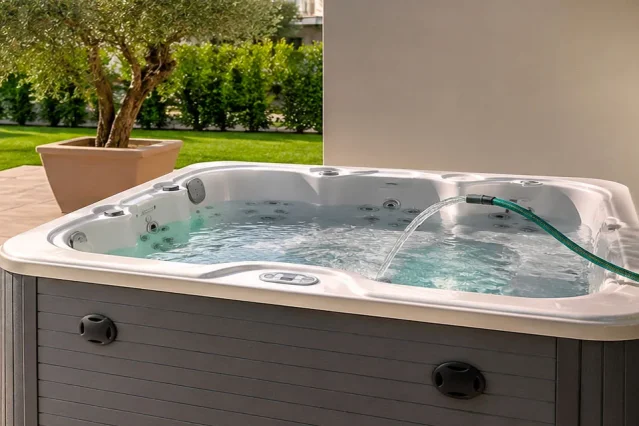
This is the biggest difference between a hot tub at home and one in an accommodation business. At home the water is managed with tablets and a cartridge, as explained in the guide on hot tub water treatment. Not in a guest facility: the standard version of the hot tub in the example below, like domestic hot tubs in general, has a paper cartridge filter, the type the guidelines rule out for commercial use. For a guest facility you need the collective use configuration, with a sand filter and automatic disinfectant dosing: it is defined at quotation stage, and it is the first line to put in writing.
The same guidelines ask the operator of every tourist accommodation to repeat the Legionella risk assessment at least every two years, preferably every year, with a competent professional (for example a hygienist, a microbiologist or an engineer with specific experience). It covers the whole water system, showers included, not just the hot tub.
Which equipment: seats, footprint and power
In a guest facility the question is not which model looks best, but how many people will use it at once, how much space you have and how much power. Here is the example of the three elements of a classic wellness circuit.
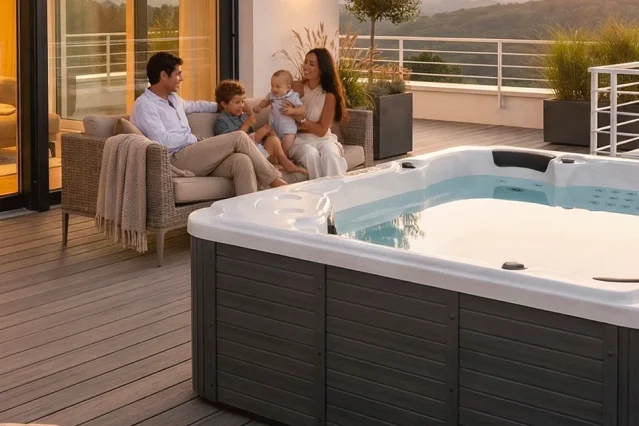
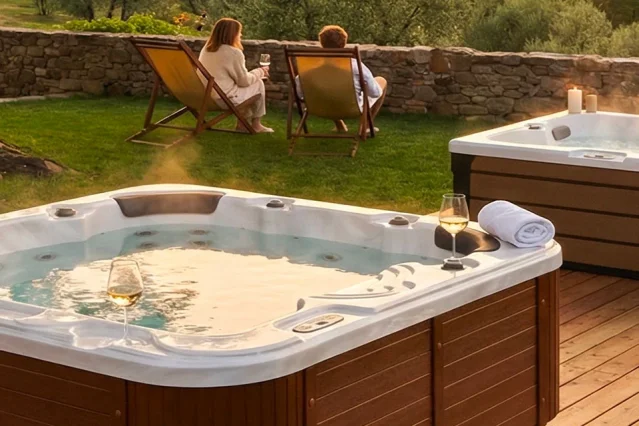
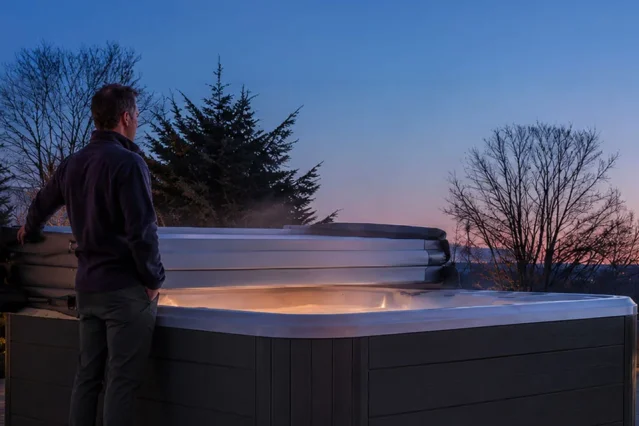
The hot tub. The BL-801 hot tub has 6 seats, one of them a lounger, and measures 210 by 220 centimetres. It holds 1,100 litres of water and has a 3,000 W heater. It weighs 387 kg empty, but with water and six people of 80 kg you reach about 1,970 kg (based on 387 kg empty), roughly 430 kg per square metre of base: it goes on a ground bearing floor, or on a slab checked by an engineer before you order.
The steam room. The BL-4B steam room seats 4 people in 130 by 190 centimetres, with a height of 225. The steam generator is 6,000 W and needs a water supply, a drain and a steam vent: the requirements are in the steam room installation sheet.
The sauna. The BL-148 Finnish sauna has 5 seats in 200 by 200 centimetres, with a 6,000 W lava stone stove. It needs no water or drain, but it does need air change in the room and the rules of use in the sauna safety sheet, to be displayed for guests.
The three heating loads together come to 15 kW, before the hot tub pumps: far more than a typical domestic supply. All three units are single phase as standard and three phase on request, so the power supply has to be decided before the order, with a dedicated line for each element. The system must be designed by a qualified professional: above 6 kW of contracted power, in an accommodation or commercial business, Italian rules (DM 37/2008) may require a design by a professional on the relevant professional register.
If you want to see hot tubs, saunas and steam rooms from our catalogue working before you decide, the where to try page lists the accommodation businesses that have installed them, with the model shown where known. They are independent businesses, so the visit is arranged with the venue.
How much it costs to open a spa: the items in the quote
The cost of building a wellness centre has no single number, but it always has the same four items. Write them all down before you compare two offers.
The equipment. At list price the BL-801 hot tub starts from € 6.766, the BL-4B steam room from € 4.451 and the BL-148 Finnish sauna from € 5.989. The list price of the hot tub refers to the standard version with a cartridge filter. The collective use configuration (sand filter and automatic dosing) has its own price, to be quoted in the same offer together with the warranty and maintenance plans for commercial use.
Services and premises. Electrical capacity and dedicated lines, mechanical ventilation for the steam, drains, the steam room water supply, showers and changing rooms if the regulations require them, and the works to bring the premises into line. They depend on the room and can only be quoted after a site visit.
Running costs. Energy, water products, periodic testing and maintenance. For energy you have two figures calculated in our guides: a sauna with a 6 kW stove, like the one in the example, costs between €2.50 and €3.60 per session at third quarter 2026 prices, as explained in the guide on sauna electricity usage; a domestic hot tub between €25 and €63 a month at first quarter 2026 prices, in the guide on hot tub running costs. These are reference prices for a household supply: on a business contract the price per kWh is different, and in a guest facility use is heavier and the hot tub pumps and disinfection run 24 hours a day. Those figures give an order of magnitude, not a quote for the running costs of the business.
Staff and paperwork. For a centre open to the public, the qualified technical manager and the SCIA. For a guest spa, someone to measure chlorine and pH during opening hours, the monthly and quarterly tests and, where the region requires it, a lifeguard.
Returns are worked out on sessions, not on square metres: how many you sell, or how many your guests use, in a month, against the four items above. A profit promised before anyone has seen the room and your customers is an estimate without data.
Frequently asked questions
What should you do before opening a wellness centre? Decide whether it is a service for the guests of an accommodation business or a business open to the public, and ask the municipality's SUAP how it is classed. Then ask the ASL for the rules on hot tub and supervision in your region, and only after that do the site visit and choose the equipment.
What do you need to open a spa? For a centre open to the public: the SCIA filed with the SUAP, a technical manager with the beautician qualification and premises that meet the regulations. For the spa of a hotel or agriturismo, at least: a check with the municipality's SUAP and with the ASL on the hot tub and supervision, automatic water treatment with a sand filter, periodic testing and the Legionella risk assessment.
How much does it cost to open a spa? Four items add up: equipment, services and premises, running costs, staff and paperwork. Equipment is the easiest to put a figure on, and this guide gives the list prices of three models; services and premises are only known after a site visit.
Is a lifeguard mandatory at hotel pools in Italy? For pools, the 2003 State and Regions Agreement requires lifeguards to be present continuously, but it lets the regions set their own implementing arrangements for accommodation businesses and does not mention hot tubs. For a hot tub, ask the ASL of your region in writing.
Do you need a beautician to open a spa? For a centre open to the public, as a rule yes: the technical manager must hold the professional beautician qualification. For a spa reserved for the guests of an accommodation business, the Modena Chamber of Commerce sheet excludes sauna, steam room and hot tub from beauty therapy when they are complementary services; elsewhere check with the municipality.
Can you open a private spa? A suite with hot tub and sauna rented exclusively, usually by the hour, is not expressly covered by any of the sources in this guide. Since it sells the use of the equipment to people who are not guests of an accommodation business, ask the SUAP in writing how it is classed, and allow for the requirements of a centre open to the public (SCIA and technical manager) until the municipality answers.
What to do, in order
Decide whether you are opening a service for guests or a centre open to the public, and ask the municipality's SUAP in writing how the business is classed in those premises.
If the centre is open to the public, find the technical manager with the beautician qualification and prepare the SCIA.
Before you order, ask the ASL how your region treats the hot tub, lifeguard included.
In the quote, ask for the collective use configuration of the hot tub, with sand filter and automatic dosing, and for the warranty terms for commercial use; have a competent professional prepare the Legionella risk assessment.
Add up the heating loads (15 kW for the hot tub, steam room and sauna in the example) and have a qualified professional design the electrical system.
Put the four items in the quote: equipment, services and premises, running costs, staff and paperwork.
The most common mistake is buying the equipment and asking the municipality afterwards what kind of business it is. It works the other way round: first the classification and the rules of your region, then the room, then the models.
The regulatory information in this guide summarises the sources cited, read in October 2026: it applies to Italy, much of it is regional and municipal, and a framework law on swimming pools is under discussion in Parliament. It does not replace the answer of the competent SUAP and ASL or the opinion of a consultant. Catalogue data (dimensions, weights, seats and prices) is read from the product pages and updates with the catalogue; weights refer to the empty product, and the operating weight given is a calculation on the stated assumptions. Energy costs are calculations on the prices indicated and vary with contract and use. No figure here replaces the structural check and the design of the services by qualified professionals.
 Skip to content